
What Makes a Car Seat FAA-Approved for Air Travel?
Quick Answer
A car seat is considered FAA-approved for air travel when it meets an accepted aircraft-use certification standard and is properly labeled. Most U.S. car seats must display the statement “This restraint is certified for use in motor vehicles and aircraft.” The seat must also fit the aircraft seat, suit your child’s size, and be installed correctly. The FAA’s child travel guidance explains these requirements.
Five things to verify before flying:
- Certification label: Find the aircraft-use statement on the car seat itself.
- Child’s size: Follow the manufacturer’s weight, height, and harness limits.
- Aircraft installation: Confirm the seat supports installation with an airplane lap belt.
- Correct restraint mode: Use an approved harness mode, not a belt-positioning booster mode.
- Airline compatibility: Check seating restrictions and available seat dimensions before departure.
Important safety reminder
- Book your child a seat: A separate ticket guarantees a place for an approved child restraint rather than depending on an empty airline seat.
Flying with a baby or toddler raises a surprisingly practical question: can you bring your everyday car seat onto the airplane? The answer depends on its certification, installation instructions, and the aircraft seating arrangement.
I recommend checking those details before packing. This guide explains exactly what makes a car seat FAA-approved, how to inspect its label, and how to avoid common boarding problems.
In This Guide
- What Does FAA-Approved Mean for a Car Seat?
- How Can You Tell Whether a Car Seat Is FAA-Approved?
- Which Car Seats and Child Restraints Are Allowed on Airplanes?
- How Do You Choose a Car Seat for Air Travel?
- How Do You Install an FAA-Approved Car Seat on an Airplane?
- What Airline Rules and Travel Problems Should Parents Know?
- Frequently Asked Questions
What Does FAA-Approved Mean for a Car Seat?
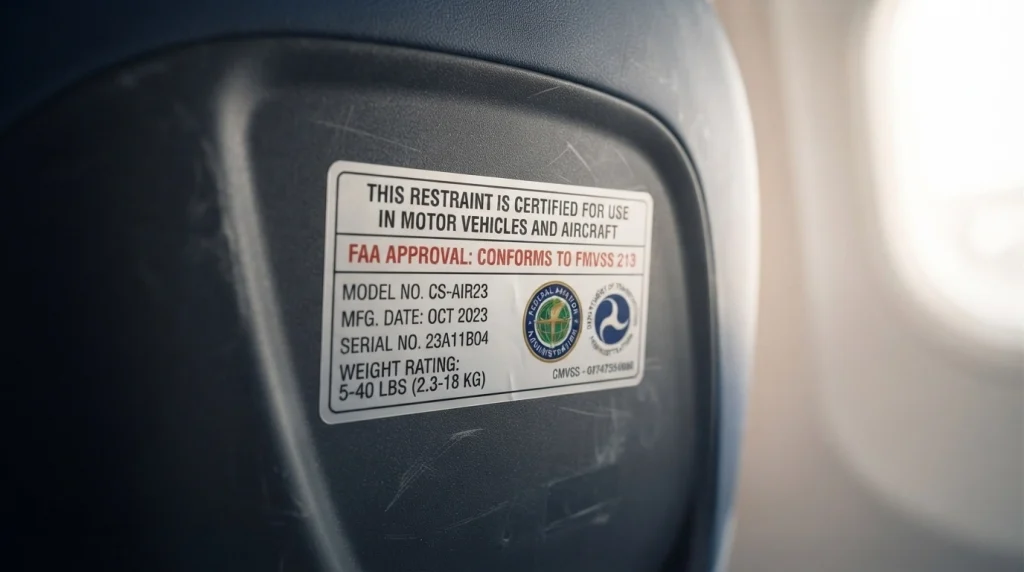
An FAA-approved car seat is a child restraint system that qualifies for use aboard an aircraft under applicable aviation regulations. However, the phrase does not necessarily mean the Federal Aviation Administration personally tested or endorsed that specific car seat model.
Most U.S. car seats obtain aircraft-use certification through the manufacturer’s compliance with applicable federal safety requirements. Other accepted restraint categories have separate approval pathways.
What is a child restraint system?
A child restraint system (CRS) is a device designed to secure a child in a seat during travel. Common examples include rear-facing infant seats and forward-facing car seats with internal harnesses.
Unlike an ordinary airplane lap belt, a properly fitted child restraint supports and secures smaller passengers according to their size. Its design helps keep the child restrained during sudden aircraft movements.
What safety standards apply?
In the United States, conventional car seats must comply with Federal Motor Vehicle Safety Standard No. 213, also called FMVSS 213. Aircraft-certified models must meet the applicable aircraft-use provisions of that standard.
Those provisions address restraint performance and occupant retention. The certification process also requires the appropriate labeling on qualifying products.
The FAA recognizes additional approval categories, including certain foreign-approved restraints and specifically approved aviation child safety devices. Its Advisory Circular 120-87C explains the regulatory framework.
Why does certification matter during a flight?
Unexpected turbulence can happen without enough warning to protect a child being held in someone’s arms. An appropriate child restraint provides a secure seating arrangement throughout the journey.
The FAA therefore strongly recommends approved child restraints, including for children younger than two. It does not generally require every child on a commercial flight to use a separate car seat.
- During taxi: A certified restraint helps keep the child secured while the aircraft moves on the ground.
- During takeoff: The harness supports the child while the aircraft accelerates.
- During turbulence: The restraint reduces reliance on an adult physically holding the child.
- During landing: The child remains secured as the aircraft decelerates.
Section Takeaway: FAA-approved describes eligibility for aircraft use, not a guarantee of compatibility with every airplane seat. Certification, child fit, and correct installation all matter.
How Can You Tell Whether a Car Seat Is FAA-Approved?
The simplest way to identify an aircraft-certified U.S. car seat is to inspect its permanent labels. Look for the official aircraft-use wording rather than relying on an online listing.
Where is the FAA certification label located?
The label normally appears on the car seat shell, often near other safety and installation information. Its exact location varies between manufacturers and models.
Check these areas carefully:
- The side of the plastic car seat shell.
- The rear exterior surface of the restraint.
- Near the manufacturer’s certification information.
- Beside other permanent warning and instruction labels.
For a U.S.-certified car seat, look for this statement:
“This restraint is certified for use in motor vehicles and aircraft.”
The required U.S. certification statement appears in red lettering. An airplane graphic or marketing sticker alone does not replace the required certification.
Can you verify approval through the owner’s manual?
Yes. The manual should identify whether the model is certified for aircraft use and explain the permitted installation method.
I would check the exact model number against its manual, especially when buying a used or older seat. Product names sometimes cover multiple versions with different instructions.
Search the manual for these terms:
- Aircraft use or airplane installation.
- Motor vehicles and aircraft certification.
- Lap-belt installation.
- Rear-facing or forward-facing aircraft instructions.
- Restrictions for booster mode or removable components.
If the certification label is missing or unreadable, contact the manufacturer before traveling. A replacement manual does not automatically prove that an unlabeled restraint is acceptable for boarding.
Does an FAA-approved car seat need a special sticker?
A U.S.-certified car seat needs the required certification labeling, but it does not necessarily carry a separate sticker saying “FAA Approved.” The official aircraft-use statement is what matters.
Some foreign-approved restraints use different markings. Confirm their acceptance under the applicable FAA rules and the airline’s requirements rather than expecting identical U.S. labels.
Pro tip: Photograph the original certification label and keep the manual accessible on your phone. Show the actual label if a crew member asks for verification.
Which Car Seats and Child Restraints Are Allowed on Airplanes?
Rear-facing infant seats and forward-facing harnessed car seats can qualify for airplane use. Belt-positioning boosters generally cannot serve as approved in-flight child restraints.
The important distinction is how the restraint secures the child. Ordinary airline seats usually provide lap belts rather than the lap-and-shoulder belts required by vehicle booster seats.
Car seat types compared for airplane travel
| Restraint type | Aircraft use | Important condition |
|---|---|---|
| Rear-facing infant car seat | Yes, when certified | Follow rear-facing installation and child-size limits. |
| Convertible car seat | Yes, when certified | Use the permitted direction and harness configuration. |
| Combination harness-to-booster seat | Sometimes | Aircraft certification generally applies only in harness mode. |
| High-back or backless booster | No, as an in-flight CRS | Requires a vehicle lap-and-shoulder belt. |
| AmSafe CARES harness | Yes | For eligible children weighing 22–44 lb and up to 40 in tall. |
| Baby carrier or ordinary travel harness | Not an approved CRS | Not permitted as an in-flight child restraint during taxi, takeoff, or landing. |
Can you use a rear-facing car seat on an airplane?
Yes, if the seat has the required certification and the child remains within its rear-facing limits. The airplane passenger seat itself still faces forward.
Position the child restraint rear-facing according to its manual. Confirm that the installation does not obstruct another passenger’s escape path.
Are convertible car seats FAA-approved?
Many convertible models carry aircraft-use certification, but approval is not universal. Check the exact model’s label and instructions.
A convertible seat may support both rear-facing and forward-facing aircraft installations. Choose the direction allowed for your child’s current height and weight.
What is the FAA-approved CARES harness?
The AmSafe Child Aviation Restraint System, commonly called CARES, is a separate aviation safety device. It uses a harness together with the existing aircraft lap belt.
The FAA-approved standard CARES device is intended for children who:
- Weigh between 22 and 44 pounds (approximately 10–20 kg).
- Are no taller than 40 inches (approximately 102 cm).
- Can sit upright independently in a forward-facing seat.
- Occupy their own airplane seat.
CARES is not approved for car travel. The FAA also warns parents about counterfeit devices, so verify the product’s authenticity and approval marking.
Section Takeaway: Not every child restraint is suitable for an aircraft. Check the exact model, approved mode, and child-size limits before buying or boarding.
How Do You Choose a Car Seat for Air Travel?
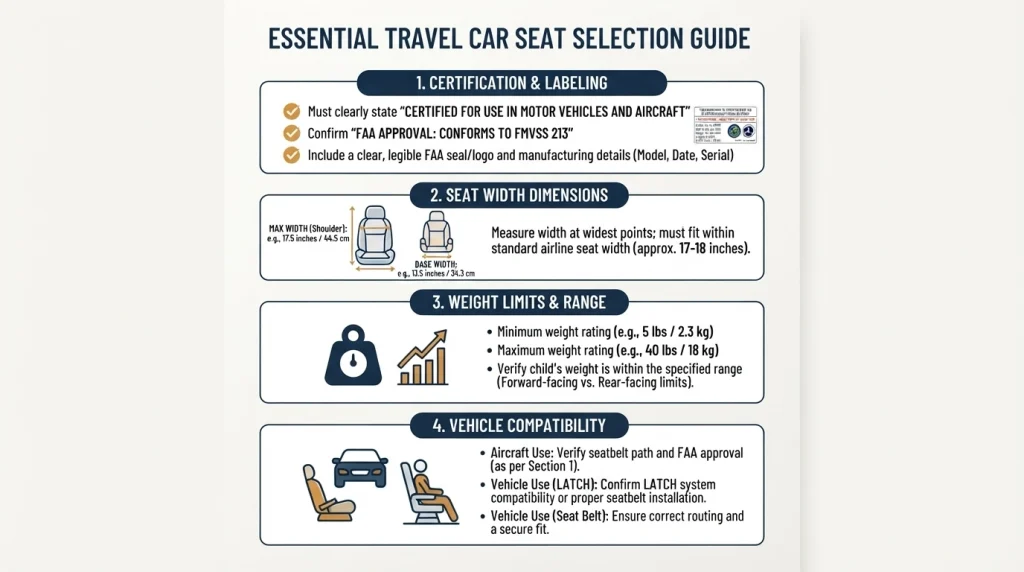
The best airplane car seat is one that fits your child, carries valid aircraft certification, and installs securely in your booked seat. Convenience matters, but it should come after safety and compatibility.
Does car seat width matter on airplanes?
Absolutely. Aircraft seats vary by airline, plane model, and cabin configuration, and fixed armrests can restrict the available space.
Do not assume every airplane seat measures 17 or 18 inches wide. Check the airline’s published seat dimensions for the aircraft assigned to your flight.
Measure your car seat across its widest rigid points, not just the bottom cushion. Compare that measurement with the airline’s available seating information.
Should you choose a lightweight travel car seat?
A lightweight car seat can make airport transfers easier, especially with luggage and a stroller. However, low weight is not an aviation safety certification.
Before buying, compare:
- Certification: Does the restraint have the required aircraft label?
- Dimensions: Will it fit the planned airplane seating position?
- Weight: Can you transport it through terminals safely?
- Installation: Can you secure it using the aircraft lap belt?
- Child fit: Does the harness properly accommodate your child?
- Vehicle use: Will it also work in your destination vehicle?
Is a more expensive car seat safer for flying?
Price alone does not determine whether a car seat qualifies for aircraft use. An expensive seat without aircraft certification is not an appropriate substitute for a certified model.
Focus on the label, correct fit, and installation instructions. The NHTSA car seat safety guide also explains child-size recommendations, installation, and ease-of-use ratings.
I would prioritize a straightforward lap-belt installation over decorative features. A seat that’s easier to install correctly offers a practical advantage during boarding.
How Do You Install an FAA-Approved Car Seat on an Airplane?
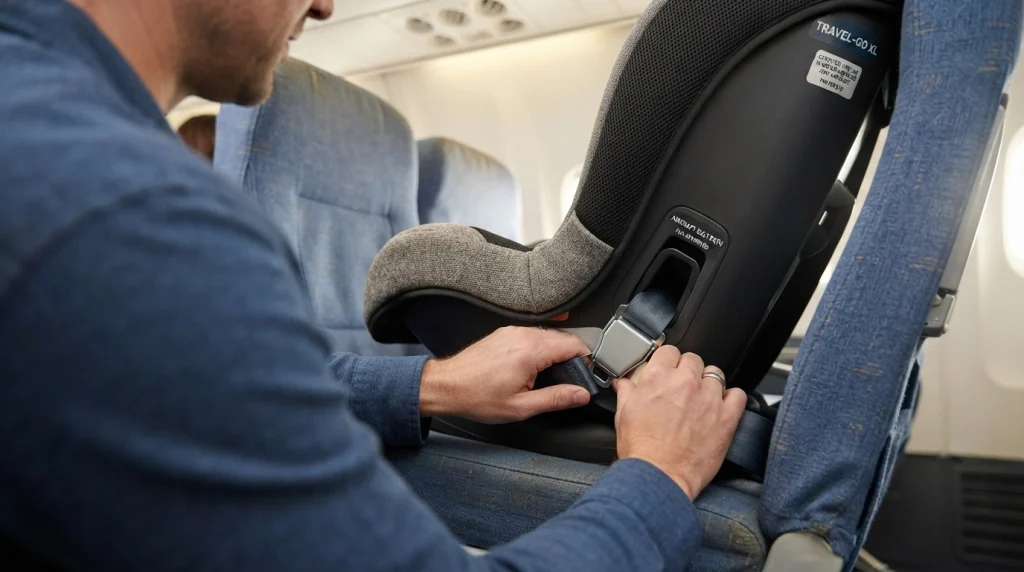
Install the certified restraint on its assigned passenger seat using the manufacturer’s aircraft instructions. Most conventional aircraft installations use the airplane lap belt routed through the appropriate car seat belt path.
Airplanes generally do not provide the LATCH lower anchors used in many cars. The restraint must support the installation method available on the aircraft.
Step-by-step airplane car seat installation
- Confirm the assigned seat. Ask the flight attendant to verify the designated child-restraint position.
- Check the aircraft seat. Identify the lap belt, buckle position, and available space.
- Position the car seat. Follow the manufacturer’s approved rear-facing or forward-facing orientation.
- Select the correct belt path. Use the aircraft installation instructions for the current restraint mode.
- Thread the lap belt. Keep the webbing flat and avoid twists.
- Buckle and tighten. Follow the manual’s instructions to secure the restraint tightly.
- Check the installation. Verify acceptable movement at the belt path according to the seat manual.
- Secure your child. Adjust and buckle the internal harness, following the manufacturer’s fit instructions.
For many car seats, the usual installation check allows no more than one inch of movement at the belt path. Always follow the requirements in your particular seat’s manual.
Where should the car seat go on the airplane?
A window seat is generally the preferred location for a child restraint. This helps avoid blocking another passenger’s access to the aisle.
Some aircraft have other acceptable positions, including certain center seating areas. The airline determines suitable locations based on evacuation safety and aircraft layout.
Never install a child restraint in an emergency exit row. Additional restrictions may apply to rows near exits or seats with unusual configurations.
Can you use a car seat with its infant base?
Some infant seats allow aircraft installation without their detachable vehicle base. Others may have different requirements or limitations.
Follow the model-specific instructions rather than assuming the base is required or prohibited. The seat must be correctly secured using an approved method.
What mistakes should you avoid?
- Using an uncertified restraint because it has an airplane symbol.
- Installing the seat through the wrong belt path.
- Using booster mode when only harness mode is aircraft-certified.
- Leaving excessive slack in the aircraft lap belt.
- Using a rear-facing angle outside the manufacturer’s limits.
- Installing the restraint where it blocks passenger evacuation.
- Assuming car-specific LATCH equipment is available on the aircraft.
If a buckle or seat structure prevents correct installation, ask the flight attendant for help finding an acceptable seating location. Do not modify the aircraft belt or car seat hardware.
Pro tip: Practice the approved lap-belt installation before travel. Consult the restraint’s current manual and airline guidance instead of relying on a generic installation video.
Section Takeaway: Aircraft certification does not replace proper installation. The correct belt path, child orientation, harness fit, and seating position remain essential.
What Airline Rules and Travel Problems Should Parents Know?
Airlines operating under U.S. aviation regulations must accommodate qualifying child restraints under applicable conditions. However, safe seating positions and aircraft configurations still affect where a restraint can be used.
Does a child need a separate airplane ticket?
Children younger than two may generally travel as lap children on U.S. commercial flights. The FAA nevertheless strongly recommends securing them in an approved child restraint in their own seat.
Purchasing a separate ticket is the reliable way to guarantee seating space for the restraint. Depending on an unoccupied seat leaves its availability uncertain.
Children aged two and older generally require their own passenger seats. They may continue using an appropriate certified restraint when it suits their size.
Can an airline refuse an FAA-approved car seat?
A U.S. airline generally cannot reject an eligible, properly labeled restraint merely because a passenger wants to use it. Still, the child must fit the restraint, and the installation must meet safety requirements.
If a ticketed, approved restraint cannot fit a particular assigned seat, the FAA states that the airline must accommodate it in another seat within the same service class. Contact the crew rather than attempting an unsafe installation.
What about international flights?
International travel requires additional planning because foreign aviation authorities may recognize different restraint certification systems. An accepted restraint on a U.S. flight might need further verification for a foreign-operated flight.
Before departure, confirm:
- The operating airline’s child restraint policy.
- The accepted certification labels or markings.
- Aircraft seating and installation restrictions.
- Requirements for connecting flights on different airlines.
- Whether the restraint meets local vehicle requirements after arrival.
Pay attention to the airline actually operating each flight rather than only the ticket seller. Codeshare trips can involve different operators and policies.
What should you prepare before arriving at the airport?
A small amount of preparation can prevent confusion during check-in and boarding. I recommend keeping the car seat instructions and booking details accessible.
- Confirm your child’s ticket and assigned seat.
- Check that the certification label remains readable.
- Inspect the restraint for damage and missing components.
- Pack the manual or save a digital copy.
- Check the aircraft seat dimensions where available.
- Allow enough time to transport and install the restraint.
- Confirm the car seat remains appropriate for your child’s current measurements.
The U.S. Department of Transportation provides additional family air travel information and airline policy links to help parents prepare.
Section Takeaway: Verify airline policies before leaving home. A purchased seat, correct certification, and suitable seating position make airplane car seat use more predictable.
Frequently Asked Questions
1. Are all car seats FAA-approved?
No. Not every car seat carries aircraft-use certification. For U.S. car seats, check for the required statement certifying use in motor vehicles and aircraft, then confirm the permitted installation method in the manufacturer’s instructions.
2. Can I use a car seat on an airplane for a child under two?
Yes. The FAA strongly recommends that infants and toddlers use an appropriate approved restraint in their own passenger seat. Although U.S. airlines generally allow children under two to travel on an adult’s lap, a separate ticket guarantees space for the restraint.
3. Can I use a booster seat during a flight?
An ordinary belt-positioning booster is not approved for use during taxi, takeoff, or landing. Aircraft lap belts generally lack the shoulder portion required by vehicle boosters. A combination car seat may qualify in its certified internal-harness mode, not booster mode.
4. Can I use a rear-facing infant car seat on an airplane?
Yes, provided the restraint is aircraft-certified, fits the designated passenger seat, and is installed according to its manual. The child’s weight and height must remain within the manufacturer’s rear-facing limits.
5. Is the CARES harness the same as an FAA-approved car seat?
No. CARES is an aircraft-only child restraint device rather than a conventional car seat. The standard FAA-approved CARES harness is designed for children weighing 22–44 pounds, measuring no more than 40 inches tall, and able to sit upright independently.
6. What if my car seat has no visible FAA certification label?
Check the shell and other permanent labels carefully, then consult the manufacturer’s instructions or customer support. Do not assume certification from an airplane icon or retailer description. Without acceptable proof of certification, you may be unable to use the restraint onboard.
7. Does the FAA require every child to use a car seat?
No. The FAA does not generally mandate child restraint systems for every child on commercial airplanes. It strongly recommends approved restraints, especially for children under two, because holding a child on your lap offers less protection during unexpected turbulence.
Final Takeaway: Check the Label Before You Fly
What makes a car seat FAA-approved for air travel comes down to valid aircraft-use certification, proper labeling, and appropriate use. For most U.S. car seats, the required certification statement is your starting point.
Before your next flight, verify the child’s size limits, read the aircraft installation instructions, and confirm the airline seating arrangement. These checks are more useful than relying on a product’s marketing description.
As of 2026, the FAA continues recommending approved child restraints rather than lap travel for young children. You can review its official child restraint FAQ when planning your trip.
Before packing your car seat, check three things: its certification label, your child’s fit, and your airline’s seating requirements. That simple checklist helps you prepare for a safer, smoother flight.

Daniel Brooks is an automotive writer and product researcher focused on car accessories, car tech, maintenance, and practical driving guides. At Plug-in Car World, he helps drivers make smarter automotive decisions through honest reviews and research-driven content.
