
What Is SensorSafe Car Seat Technology? How It Works and Why It Matters
Quick Answer
SensorSafe car seat technology is a smart child-safety monitoring system built into compatible car seats. It uses an electronic chest clip and Bluetooth connectivity to warn caregivers about four potentially dangerous situations. Developed for compatible products from brands including Evenflo and CYBEX, SensorSafe technology adds electronic reminders without replacing proper car seat installation or adult supervision.
Four Main SensorSafe Alerts
- Unbuckled chest clip: Warns when the electronic chest clip opens during a trip.
- Unsafe cabin temperature: Notifies caregivers when the monitored vehicle temperature becomes too hot or cold.
- Extended seating: Provides a reminder after approximately two hours of continuous seating.
- Child-left-in-car warning: Alerts caregivers when the system detects circumstances suggesting a buckled child remains in the vehicle.
- Connected notifications: Uses a compatible smartphone application, with additional receiver functions on certain models.
Important Safety Reminder
- SensorSafe is a backup warning system, not a guarantee against injury or emergencies. Always check the back seat before leaving your vehicle.
Modern child car seats do more than provide crash protection. Some models now include technology that helps caregivers notice hazards they might otherwise miss.
As someone who pays attention to how automotive safety equipment works, I find the difference between a helpful warning and a guaranteed safeguard especially important. This guide explains SensorSafe’s features, compatibility, setup, limitations, and practical value for everyday families.
In This Guide
- What Is SensorSafe and How Does It Work?
- What Safety Alerts Does SensorSafe Provide?
- Which Car Seats Have SensorSafe Technology?
- How Do You Set Up and Troubleshoot SensorSafe?
- Is SensorSafe Better Than a Regular Car Seat?
- What Are the Benefits and Limitations of SensorSafe?
- Frequently Asked Questions About SensorSafe
What Is SensorSafe and How Does It Work?
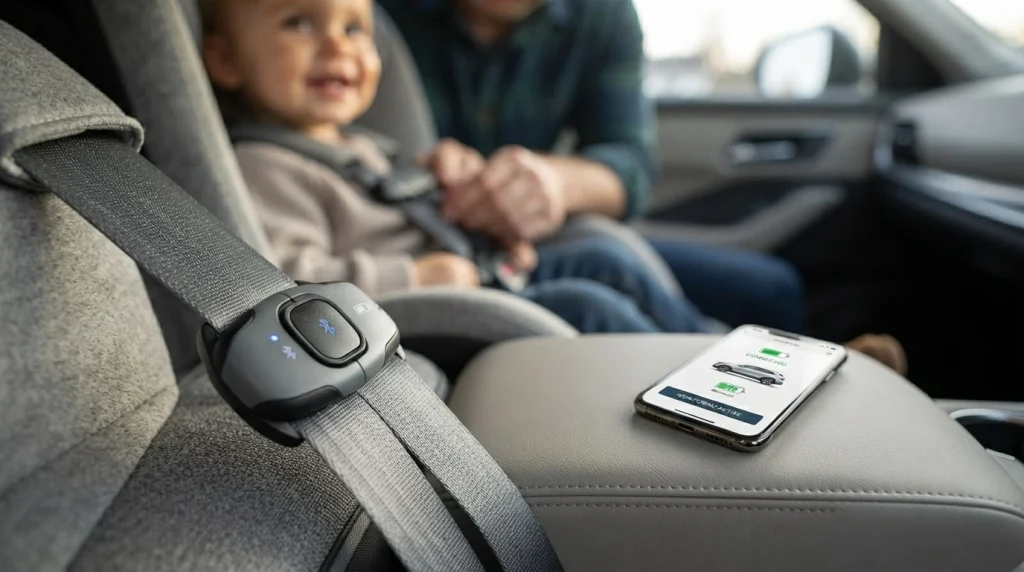
SensorSafe is an electronic child car seat monitoring system that uses a specially designed chest clip to communicate safety information. Its main purpose is to alert caregivers to certain risks during or after a vehicle journey.
The technology supplements the physical protection provided by a properly installed child restraint. It does not replace the seat’s harness, shell, energy-management features, or installation requirements.
What Makes a SensorSafe Chest Clip Different?
A conventional chest clip helps position the shoulder harness straps as the car seat manufacturer intends. A SensorSafe chest clip adds electronic components for monitoring selected conditions.
Depending on the version, the system includes these parts:
- Smart chest clip: Contains electronics that detect the clip’s open or closed state and monitor relevant conditions.
- Bluetooth connection: Allows the clip to communicate with a compatible smartphone.
- Mobile application: Displays alerts, device information, and available caregiver settings.
- Vehicle receiver: Certain systems use a receiver connected to the vehicle’s onboard diagnostics port, commonly called OBD-II.
- Emergency contact settings: Supported versions can notify designated contacts after specific unattended-child alerts.
The exact hardware arrangement depends on the manufacturer, product generation, and region. Not every SensorSafe car seat operates with an identical combination of components.
How Does SensorSafe Communicate With Your Phone?
Bluetooth provides short-range wireless communication between compatible devices. When the SensorSafe system detects a supported warning condition, the app can display a notification.
For example, an opened chest clip may trigger an alert while the car is moving. A temperature warning can appear when the monitored environment crosses the system’s programmed threshold.
Some versions also provide audible warnings through a vehicle receiver. These receiver-based alerts may operate even when the smartphone app is unavailable.
However, smartphone-only features generally depend on successful pairing, permissions, and the app working correctly. An interrupted connection can prevent expected notifications.
Does SensorSafe Monitor a Child’s Health?
No. SensorSafe is a safety-alert system rather than a medical monitoring device.
It does not directly measure a child’s breathing, heart rate, blood oxygen, or core body temperature. Its temperature feature monitors the surrounding environment instead.
The system also cannot confirm that a child has been positioned correctly or that the car seat has been installed securely.
Section Takeaway: SensorSafe adds electronic hazard alerts to compatible child restraints. The car seat’s ordinary safety systems remain responsible for protecting the child during a crash.
What Safety Alerts Does SensorSafe Provide?
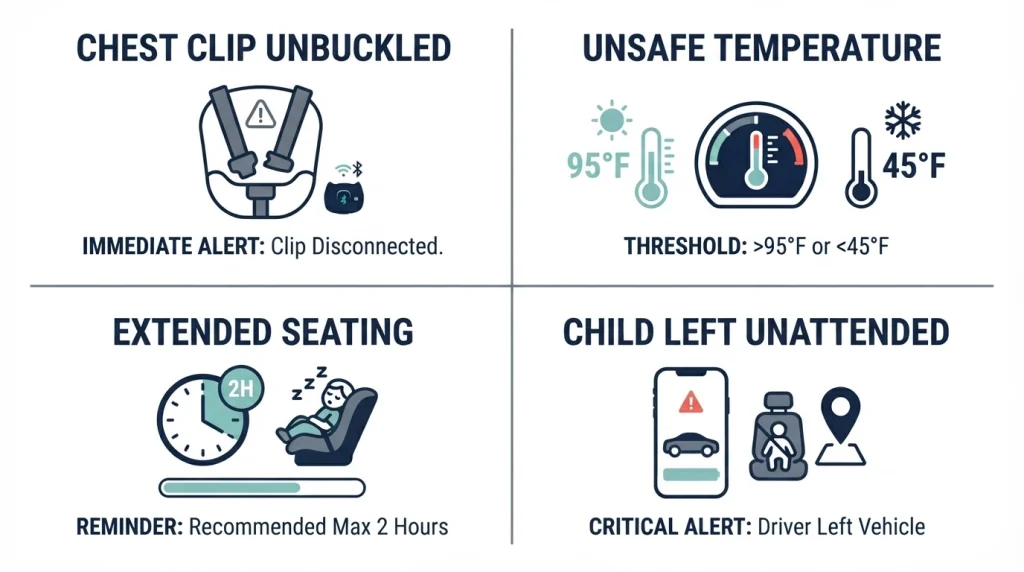
SensorSafe is commonly described as a four-alert safety system. Each warning addresses a different situation that may require caregiver attention.
1. Chest Clip Unbuckled Alert
Some children learn to open their chest clips as they grow. This can compromise the intended harness positioning before the driver notices.
SensorSafe detects when its electronic clip opens and can send an alert during the journey.
Consider a toddler riding behind the driver on a busy highway. If the child opens the clip, the system may warn the caregiver without requiring constant visual checks.
What to do: Stop somewhere safe, inspect the harness, and secure the child according to the car seat manual. Never attempt to rebuckle or adjust the child while driving.
2. Unsafe Temperature Alert
Vehicle interiors can experience substantial temperature changes. Young children may be particularly vulnerable to excessive heat.
According to Evenflo’s published SensorSafe guidance, its temperature alerts activate at approximately:
- High temperature: 95°F (35°C).
- Low temperature: 45°F (approximately 7.2°C).
These are manufacturer-defined alert thresholds, not universal medical safety limits. A dangerous situation can develop before an alert appears.
The sensor measures ambient temperature near the car seat rather than the child’s body temperature. Direct sunlight, ventilation, and changing cabin conditions can influence the surrounding environment.
What to do: Check your child and the cabin environment immediately. Never interpret the absence of a warning as proof that the temperature is safe.
3. Extended Seating Reminder
Long drives can keep children in a car seat for extended periods. SensorSafe includes a reminder after roughly two hours of continuous seating.
The feature encourages caregivers to stop and reassess the child’s needs. It is not a medical determination that every child can safely remain seated for two hours.
For a family road trip, I would treat this notification as a useful planning reminder. A planned stop is preferable to rushing because an alert appeared.
During a suitable break, caregivers can:
- Remove the child from the seat in a safe location.
- Check comfort and general well-being.
- Allow age-appropriate movement and rest.
- Address feeding, hydration, or diaper needs as appropriate.
- Inspect the harness before continuing the trip.
Infants and children with particular health needs may require more frequent stops. Follow advice from their healthcare professional when applicable.
4. Child Left Unattended Alert
The child-left-in-car warning is one of SensorSafe’s most important features. It is designed to alert a caregiver when a buckled child may have been left inside a vehicle.
Depending on the version, the system uses information from the chest clip, smartphone, and vehicle receiver. It can respond when conditions suggest the caregiver has walked away while the clip remains fastened.
Supported applications may also provide notifications to designated emergency contacts if the primary caregiver does not respond.
This feature needs careful interpretation. It does not mean SensorSafe can independently detect every child in every parked vehicle.
A child who is not buckled into the compatible clip may not trigger the same reminder. Phone connectivity and system configuration also matter.
The National Highway Traffic Safety Administration’s heatstroke prevention guidance emphasizes that children should never be left unattended in a vehicle.
Section Takeaway: SensorSafe’s four alerts cover chest clip opening, cabin temperature, long seating periods, and potential unattended-child situations. None of these notifications replaces direct supervision or prompt action.
Which Car Seats Have SensorSafe Technology?
SensorSafe is available only on supported child car seat models. The technology is not a universal feature across infant seats, convertible seats, or booster seats.
As of 2026, manufacturer product listings identify compatible offerings from Evenflo and CYBEX. Exact availability varies by model, region, and product configuration.
Evenflo Car Seats With SensorSafe
Evenflo offers SensorSafe on selected products, including models within its infant and rotating car seat ranges.
Examples listed in the manufacturer’s SensorSafe collection include:
- Evenflo Gold Revolve360 Slim: A rotating convertible-style car seat offered in a SensorSafe-equipped configuration.
- Evenflo Gold Revolve360 Extend: An all-in-one rotating car seat offered with SensorSafe on selected versions.
- Evenflo LiteMax NXT: An infant car seat with SensorSafe-equipped versions.
These are compatibility examples, not a ranking or recommendation for every child. Always verify the specific product listing before purchasing.
CYBEX SensorSafe Car Seat Technology
CYBEX also offers SensorSafe technology on supported child restraint products. Its connected safety system provides warnings related to the chest clip, temperature, seating duration, and unattended-child situations.
Some CYBEX markets offer a dedicated safety clip or approved kit for specified seats. That does not make the component compatible with every CYBEX car seat.
The manufacturer’s CYBEX SensorSafe information explains the connected safety functions and provides guidance about supported equipment.
Can SensorSafe Be Added to Any Existing Car Seat?
No. A SensorSafe chest clip should never be treated as a universal aftermarket accessory.
Evenflo specifically states that its SensorSafe clip must remain with the seat for which it was supplied. Moving it onto another car seat can compromise the approved configuration.
Manufacturer-authorized CYBEX upgrade options must also be restricted to explicitly compatible products. Do not assume a separately available clip will work with your restraint.
What Should You Check Before Buying?
Before selecting a SensorSafe-enabled car seat, verify these details:
- Child fit: Height, weight, and developmental requirements.
- Seat type: Rear-facing infant, convertible, or all-in-one configuration.
- Vehicle fit: Installation method, available seating space, and vehicle compatibility.
- SensorSafe inclusion: Confirm that the exact model and configuration include the technology.
- Phone compatibility: Supported operating system and required application.
- Receiver requirements: Whether the product needs a vehicle dongle or another component.
- Regional support: Availability of the relevant app and customer service.
A compatible electronic system matters only after the physical car seat fits correctly. I would always prioritize child size, installation, and harness usability over smart features.
How Do You Set Up and Troubleshoot SensorSafe?
SensorSafe setup varies between product generations, but most supported systems require an initial connection procedure. Always follow the instructions supplied with your specific car seat.
Basic SensorSafe Setup Steps
- Install the child car seat. Follow the restraint manual and vehicle owner’s manual before configuring electronic features.
- Identify your SensorSafe version. Check whether the product requires a vehicle receiver, smartphone connection, or both.
- Install the correct application. Use the manufacturer-specified app from the official Apple App Store or Google Play Store.
- Enable required permissions. Allow Bluetooth, notifications, and any location or background permissions needed for the supported features.
- Pair the device. Follow the application’s instructions for activating and connecting the smart chest clip.
- Configure caregiver settings. Add emergency contacts if the version offers that feature.
- Test the system. Verify supported notifications with the child out of the seat, following the manufacturer’s test instructions.
Evenflo instructs users of its applicable SensorSafe versions to begin setup with the chest clip unbuckled. Other versions may use a different pairing sequence.
Use the exact instructions for your installed hardware rather than relying on an unrelated tutorial.
What Should You Do If SensorSafe Is Not Connecting?
A failed connection does not necessarily mean the physical car seat is defective. Electronic features may stop working because of settings, compatibility, or component problems.
Try these checks in order:
- Bluetooth: Confirm that Bluetooth is enabled on the paired phone.
- App status: Update the official application and confirm it is permitted to run in the background.
- Notifications: Check notification permissions, volume settings, and modes that silence alerts.
- Phone compatibility: Recheck operating system support and manufacturer requirements.
- Receiver connection: If your system uses a vehicle receiver, confirm installation according to its manual.
- Device power: Check the manufacturer-approved battery or power-service guidance.
- Pairing: Repeat the approved setup procedure if the application reports a disconnected device.
Do not dismantle or modify the chest clip to investigate an electronic fault. Contact the manufacturer if the system remains unreliable.
How Often Should You Test SensorSafe?
The manufacturer should determine formal testing and maintenance requirements. However, checking the connection before relying on its alerts is a sensible routine.
I would make a short electronic check part of the same pre-trip routine used for inspecting the harness. It is especially useful after changing phones, reinstalling the app, or switching vehicles.
For detailed assistance, consult Evenflo’s official SensorSafe questions and setup guidance.
Is SensorSafe Better Than a Regular Car Seat?
SensorSafe offers additional warning functions, but that does not automatically make a car seat more protective during a crash. Crash protection depends on the restraint’s design, certification, proper installation, and correct use.
The main difference is electronic monitoring rather than the basic purpose of the car seat.
SensorSafe vs. Standard Car Seat Comparison
| Feature | SensorSafe Seat | Standard Seat |
|---|---|---|
| Crash restraint function | Provided by the car seat design and harness | Provided by the car seat design and harness |
| Chest clip opening alert | Available on supported systems | Not normally included |
| Cabin temperature warning | Supported through connected alerts | Not normally included |
| Long seating reminder | Approximately two-hour reminder | Caregiver-managed |
| Child-left-in-car notification | Available under supported conditions | Not normally integrated |
| Smartphone setup | Needed for connected app features | Not required for basic use |
| Electronic maintenance | May require updates and device checks | No comparable smart system to maintain |
Does SensorSafe Improve Crash Protection?
SensorSafe’s electronic alerts are not a substitute for crash-tested restraint features. A standard car seat that fits correctly and is used properly can provide appropriate crash protection.
An expensive connected seat installed incorrectly can still expose a child to serious risk. Technology does not correct a loose installation or poorly adjusted harness.
The NHTSA car seat safety guide recommends choosing a seat suited to the child’s age and size, installing it correctly, and following manufacturer instructions.
Who Might Benefit Most From SensorSafe?
The technology may appeal to families who value extra reminders during busy travel routines. Its usefulness depends on how consistently the connected system operates.
Potentially helpful situations include:
- Families with toddlers: A chest clip warning may identify an opened clip sooner.
- Long-distance travelers: Seating reminders encourage planned breaks.
- Households with multiple caregivers: Correctly configured alerts provide another layer of reminders.
- Drivers in variable climates: Temperature notifications can draw attention to changing cabin conditions.
For these families, SensorSafe may add practical value. It should never be the only reason for choosing a particular car seat.
Section Takeaway: SensorSafe provides additional warning capabilities, not a guaranteed improvement in crash performance. Correct seat fit and installation remain the most important buying priorities.
What Are the Benefits and Limitations of SensorSafe?
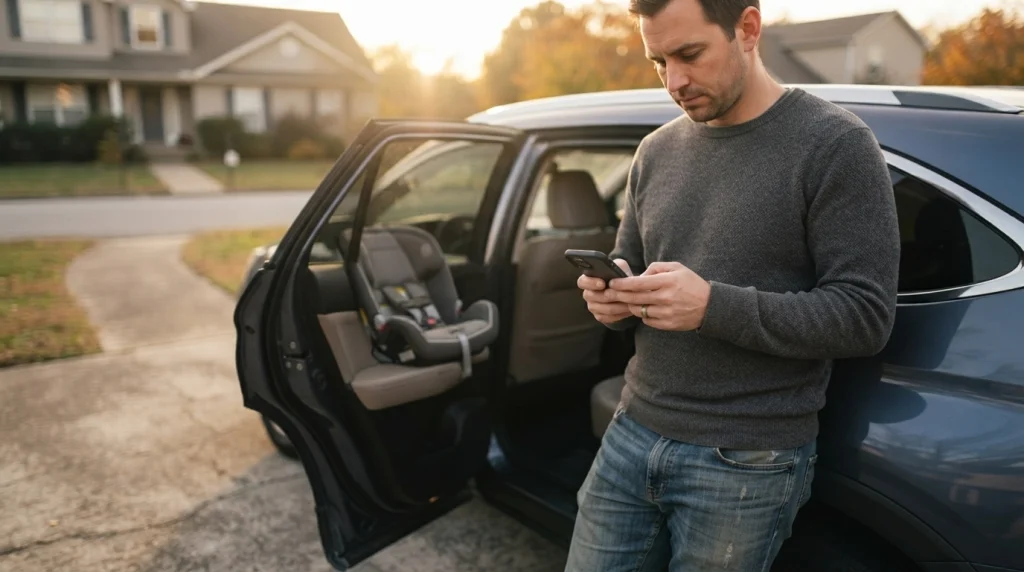
Understanding SensorSafe’s limitations is just as important as understanding its benefits. Connected technology works best when users know exactly what it can and cannot detect.
What Are the Main Benefits?
- Earlier awareness: Certain unsafe conditions may trigger warnings before a caregiver notices them independently.
- Additional reminders: Alerts support more consistent checks during everyday travel.
- Temperature information: Cabin warnings can encourage faster attention to uncomfortable or hazardous conditions.
- Trip management: Extended seating notifications provide a prompt to consider breaks.
- Connected caregiver support: Supported versions allow designated contacts to receive selected emergency notifications.
The strongest advantage is an extra opportunity to notice and respond to a problem. That is different from claiming the technology can prevent every dangerous situation.
What Are SensorSafe’s Limitations?
The system relies on electronic components and specific operating conditions. Several factors can interfere with the expected warnings.
- Connectivity interruptions: Bluetooth pairing may fail or disconnect.
- Notification settings: Silenced notifications or restricted permissions can affect alerts.
- Battery or power problems: Electronic components require their specified power source.
- Compatibility restrictions: The system only works with supported seats, devices, and configurations.
- Limited measurements: It cannot monitor every aspect of a child’s health or positioning.
- Caregiver response: Receiving a warning does not guarantee someone will see it or act immediately.
Is SensorSafe Worth the Extra Cost?
It can be worthwhile when the compatible car seat already fits your child and vehicle well. The added value comes from useful alerts rather than improved physical crash protection alone.
There is no universal SensorSafe price premium. Costs vary by car seat model, manufacturer, retailer, and included equipment.
Instead of comparing electronic features alone, assess the complete product:
- Does the seat fit your child’s current size and expected growth?
- Can you install it correctly in your vehicle?
- Is the harness easy to adjust every time?
- Does the supported SensorSafe system work with your phone and vehicle?
- Are replacement parts, manuals, and customer support available?
- Does the overall price fit your budget?
A standard seat may be the better purchase when it fits more securely or is easier to use correctly. Smart technology should support a good restraint, not compensate for a poor fit.
How Can Caregivers Use SensorSafe More Safely?
The most useful approach combines electronic alerts with consistent human checks. I prefer routines that still work when a phone battery dies or an app disconnects.
Build these habits into every journey:
- Check the car seat installation and harness before departure.
- Confirm the child is buckled correctly and the chest clip is positioned as directed.
- Check that the SensorSafe system is connected when using its electronic features.
- Respond to warnings only after stopping safely when driving.
- Inspect the rear seat every time you park.
- Remove every child from the vehicle before leaving it unattended.
Pro tip: Review the car seat manual, vehicle owner’s manual, and official recall information regularly. A certified child passenger safety technician can also help evaluate installation and harness use.
Section Takeaway: SensorSafe is most valuable as a secondary alert system paired with reliable safety habits. A disconnected app, silent phone, or electronic failure must never leave a child dependent on technology alone.
Frequently Asked Questions About SensorSafe
Does SensorSafe Work Without a Smartphone?
Some SensorSafe versions include a vehicle receiver that can provide audible reminders without the mobile app. However, temperature alerts, unattended-child notifications, and other connected features generally require a compatible smartphone and correctly configured application. Check the instructions for your exact model.
Does SensorSafe Require Wi-Fi or Internet Access?
SensorSafe uses Bluetooth for supported short-range communication. Basic local communication does not necessarily require Wi-Fi, but certain connected functions may need phone services, permissions, or data connectivity. Emergency contact notifications should never be assumed to work without the required connection.
Can SensorSafe Detect Whether a Child Is Breathing?
No. SensorSafe is not a breathing or medical vital-sign monitor. It detects selected conditions involving the electronic chest clip, surrounding temperature, and supported travel situations. It cannot diagnose breathing problems or guarantee that a sleeping child is medically safe.
Can SensorSafe Prevent Hot Car Deaths?
SensorSafe can provide alerts that may help a caregiver notice a potentially unattended child. However, it cannot prevent every incident, and warnings can fail or be missed. The safest practice remains removing children from the vehicle and checking the entire back seat every time.
Can I Transfer a SensorSafe Clip to Another Car Seat?
Do not transfer a SensorSafe clip unless the manufacturer explicitly approves the exact configuration and procedure. Evenflo states that its supplied clip must stay with its original compatible seat. Any approved CYBEX accessory must also be used only with the models specified by CYBEX.
Does SensorSafe Automatically Call Emergency Services?
SensorSafe should not be treated as an automatic emergency-services calling system. Supported versions may alert configured emergency contacts during certain unattended-child scenarios. That is different from guaranteeing direct contact with police, firefighters, or emergency medical responders.
Does SensorSafe Make a Car Seat Safer Than a Regular Seat?
SensorSafe adds electronic warnings that conventional seats usually lack. It does not automatically mean better crash-test performance or stronger physical protection. A correctly selected, installed, and used child restraint remains essential regardless of whether it includes connected safety technology.
Final Takeaway: Should You Choose a SensorSafe Car Seat?
SensorSafe car seat technology offers a useful extra layer of awareness through its connected chest clip and four principal safety alerts. For families who value reminders and can maintain the system correctly, those features may be a meaningful benefit.
Start with a car seat that fits your child and vehicle, then decide whether SensorSafe’s connected features meet your needs. Always test the system, follow the manufacturer instructions, and maintain a consistent back-seat checking routine.
My practical recommendation: Choose fit, correct installation, and ease of daily use first. Treat SensorSafe as an additional safeguard, never the final safeguard.

Daniel Brooks is an automotive writer and product researcher focused on car accessories, car tech, maintenance, and practical driving guides. At Plug-in Car World, he helps drivers make smarter automotive decisions through honest reviews and research-driven content.
