Coverking vs Platinum Shield — Which Car Cover Fits Your Budget?
Quick Answer
Platinum Shield wins on weatherproofing and included accessories. Coverking Triguard wins on true custom fit and price. Platinum Shield uses a reflective, water-resistant outer layer with a soft fleece lining, and it ships with a cable lock, gust strap, storage bag, and antenna patch. Coverking Triguard is a lighter three-layer polypropylene cover built from your vehicle’s exact year, make, and model — it costs less but skips the fleece lining and the bundled accessories. Coverking also sells heavier fabrics (StormProof, Mosom Plus, Coverbond 4) if you want more protection than Triguard offers, at a higher price closer to Platinum Shield.
Coverking Triguard vs Platinum Shield — the real difference:
- Platinum Shield includes a fleece lining; Triguard does not
- Coverking builds a true custom pattern to your VIN specs
- Platinum Shield bundles a lock, gust strap, and storage bag free
⚡ Quick Verdict — Coverking vs Platinum Shield
Coverking Triguard
Custom-fit from $189.99 (varies by vehicle)
✅ Best for:
Garage or carport vehicles that only need light outdoor protection
Platinum Shield
~$194.95–$219.95 (sedan/coupe sizing)
✅ Best for:
Daily outdoor parking in sun, rain, or occasional snow
| Category | Triguard | Platinum Shield |
|---|---|---|
| Overall Winner | — | 🏆 |
| Best Value | ✅ | ❌ |
| Fleece-Lined Interior | ❌ | ✅ |
| True Custom Pattern (VIN-Specific) | ✅ | ❌ |
| Free Accessories Included | ❌ | ✅ |
Bottom line: Platinum Shield wins for daily outdoor parking — the fleece lining and bundled accessories justify the higher price. Triguard is worth it only if your car spends most of its time under a carport or in light weather.
Picking a car cover gets confusing fast once you compare brands side by side. Coverking and Platinum Shield both show up in car forums and buying guides, and on the surface they look similar — both promise UV protection, both keep rain off your paint.
The real differences show up in the fabric, the fit method, and what’s actually included in the box. This guide breaks down Coverking’s Triguard line against CarCovers.com’s Platinum Shield cover, using published specs, warranty terms, and independent reviews from outlets that have tested both.
Product Overview: Coverking Triguard
| ✅ Best for | Vehicles kept in a carport or garaged most of the time |
| ❌ Not ideal for | Daily outdoor parking in rain or snow — step up to Coverking StormProof instead |
| 💰 Price | Custom-fit Coverking covers start at $189.99 (check Amazon for current pricing) |
Coverking is a California-based manufacturer that builds vehicle covers to order. Triguard is its entry-level fabric: three layers of UV-treated polypropylene, reinforced double-stitched seams, and non-scratch security grommets for a cable lock.
Every Coverking custom cover is patterned to your vehicle’s specific year, make, and model, with mirror and antenna pockets built in where applicable. That’s a genuine custom fit, not a size-based approximation.
Triguard is not built for heavy rain or snow. Coverking positions it for carport use or occasional outdoor storage, and most buyers agree it’s the right pick when the goal is light dust and UV protection rather than full weatherproofing.
Coverking backs its covers with a two-year defect warranty, plus a paid “Coverking Care” repair or refurbish program after that warranty expires. That long-term repair option is something Platinum Shield doesn’t publicly offer.
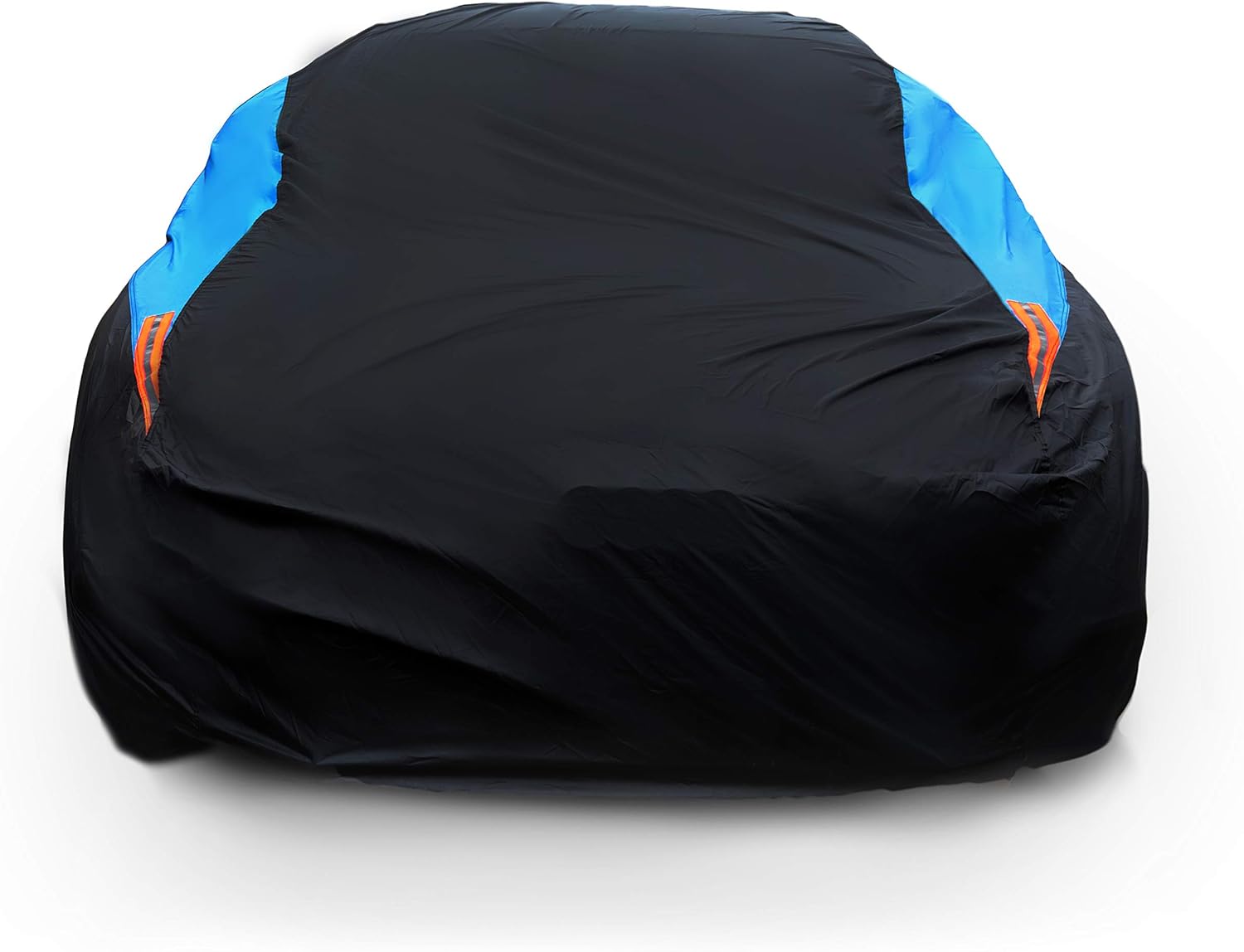
Coverking Triguard Universal Car Cover, Sedans up to 22′
Good fit for buyers who want Coverking’s fabric without ordering a full custom pattern.
Product Overview: Platinum Shield
| ✅ Best for | Vehicles parked outside daily in sun, rain, or light snow |
| ❌ Not ideal for | Buyers who want a true VIN-specific pattern — it’s sized, not fully custom |
| 💰 Price | Roughly $194.95–$219.95 for cars, higher for SUVs and trucks (check for latest price) |
Platinum Shield is CarCovers.com’s flagship cover, sold under its parent company AllGuard. It’s built from woven polyester with a reflective urethane coating on the outside and a soft fleece lining on the inside.
Instead of a true custom pattern, Platinum Shield uses semi-custom sizing: you enter your vehicle’s year, make, and model, and the company matches it to the closest length, width, and height profile. Independent testers have called the resulting fit “pretty good” and close to a full custom cover at a lower cost.
Every order ships with a cable-and-lock set, a gust strap for high-wind areas, a storage bag, and an antenna patch kit. Coverking sells these as separate add-ons, so Platinum Shield’s bundle narrows the effective price gap between the two brands.
The Drive named the CarCovers.com Platinum Shield its top overall pick after hands-on testing, citing the fit and material quality as the reason it earned the higher price tag. One CorvetteForum owner using it on a C8 called it well made and reasonably priced.
AllGuard Platinum Shield Car Cover, Sedans/Coupes/Convertibles
Right choice for daily outdoor parking with real weatherproofing.
Full Spec Comparison: Coverking vs Platinum Shield
Triguard wins on price and true custom fit; Platinum Shield wins on weatherproofing and included extras. Triguard starts at $189.99 for a custom pattern, while Platinum Shield runs roughly $194.95 and up depending on vehicle size. But Platinum Shield’s fleece lining and bundled accessories close much of that price gap in real value.
| Spec | Coverking Triguard | Platinum Shield | Winner |
|---|---|---|---|
| Starting Price | $189.99 | ~$194.95 | Triguard |
| Fabric Layers | 3-layer polypropylene | Woven polyester + urethane coating | Platinum Shield |
| Interior Lining | None | Soft fleece | Platinum Shield |
| Fit Method | Custom, VIN-based pattern | Semi-custom, size-based | Triguard |
| Weather Rating | Light to medium weather | Rain, snow, and sun | Platinum Shield |
| Included Accessories | Sold separately | Lock, strap, bag, antenna patch | Platinum Shield |
| Warranty | 2-year defect + lifetime repair program | Manufacturer warranty (see listing) | Triguard |
Which Fabric Wins for Daily Outdoor Weather?
Platinum Shield wins for daily outdoor weather. Its reflective urethane-coated polyester and fleece lining are built to handle sun, rain, and light snow without upgrading to a heavier line. Triguard’s three-layer polypropylene is UV-treated but not designed for sustained rain or snow exposure.
If your vehicle sits outside every night, Platinum Shield is the safer everyday choice. If it’s usually under a roof or in a garage, Triguard’s lighter fabric is enough, and Coverking’s breathable design still helps prevent trapped condensation underneath.
Buyers who need more protection than Triguard offers, but want to stay with Coverking, can step up to StormProof or Coverbond 4 instead of switching brands entirely. Those fabrics compete more directly with Platinum Shield on weatherproofing, at a higher price than Triguard.
Which Fit Method Actually Fits Better?
Coverking wins on fit precision. Its custom covers are patterned to your vehicle’s specific year, make, model, and configuration, with mirror and antenna pockets built into the design. Platinum Shield uses semi-custom sizing based on your vehicle’s length, width, and height instead.
That doesn’t mean Platinum Shield fits poorly. One independent reviewer called the fit “pretty good,” noting it sits mostly taut with enough clearance for airflow underneath. But it’s not a true custom pattern, and newer orders no longer include mirror pockets.
If a snug, mirror-pocketed fit matters most to you, Coverking’s custom process delivers it. If you want a close fit without the wait for a made-to-order pattern, Platinum Shield’s semi-custom sizing is the faster path.
Price & Value: Which Cover Costs Less to Own?
Coverking Triguard has the lower sticker price, starting at $189.99 for a custom pattern. Platinum Shield starts around $194.95 for a sedan and climbs toward $270 or more for SUVs and trucks, based on published listings.
The gap narrows once you factor in accessories. Coverking sells its cable-and-lock set and storage bag separately, while Platinum Shield bundles both free with every order, along with a gust strap and antenna patch kit.
For buyers who’d need to add those extras to a Triguard cover anyway, Platinum Shield’s all-in price is more competitive than the sticker prices suggest.
Safety, Warranty & Unique Features
Coverking wins on long-term support. It backs every custom cover with a two-year defect warranty, then offers a paid Coverking Care program to repair or refurbish the cover indefinitely after that. Platinum Shield’s coverage is tied to its standard manufacturer warranty listed on each product page.
Platinum Shield’s standout feature is its bundled hardware. The cable-and-lock set deters theft, and the gust strap is specifically recommended for high-wind regions where a standard elastic hem isn’t enough to keep a cover in place.
Neither cover should go on a wet vehicle, and Coverking specifically warns against covering a car with the convertible top down or a recently painted surface before the paint has fully cured.
Coverking’s fabric lineup is also broader. Triguard is the economy option, but the same brand offers Mosom Plus for hail protection and StormProof for heavier all-weather use, so you can move up within one manufacturer’s warranty and support system as your needs change.
Real-World Use Cases: Which One Wins?
Which cover wins depends on where and how often the vehicle sits outside. Below are common situations and the better match for each.
- Daily street parking in a rainy climate: Platinum Shield wins — its reflective coating and fleece lining are built for sustained outdoor exposure.
- Cold-weather storage with occasional snow: Platinum Shield wins, based on owner reports of use through Toronto winters.
- Garaged car that only needs dust protection: Triguard wins — its lighter fabric and lower price fit light-duty use.
- Classic or collector car kept under a carport: Triguard wins for the true custom pattern and gentler fabric weight.
- High-wind coastal areas: Platinum Shield wins because it includes a gust strap at no extra cost.
- Budget-conscious buyers ordering their first cover: Triguard wins on lower starting price.
Is Platinum Shield Worth the Extra $30 Over Triguard?
Platinum Shield is worth the premium if your car parks outside daily, since the fleece lining and included accessories add real value beyond the price gap. For a garaged or carport vehicle, Triguard’s lower price is the better call.
Coverking’s custom covers start at $189.99 and rise from there depending on fabric and vehicle size. Platinum Shield starts around $194.95 for sedans, and independent reviews put SUV pricing closer to $209, with truck sizing running higher still.
Prices on both brands shift with sales and vehicle configuration, so always check the current listing before ordering. If you’d need to buy a lock and storage bag separately for a Triguard cover, the real price difference between the two brands shrinks close to zero.
Who Should Buy Which?
Buy Platinum Shield if you park outside daily and want weatherproofing plus accessories in one order. Buy Coverking Triguard if your vehicle is mostly garaged and you want the closest possible custom fit at a lower price.
- Garage or carport your vehicle most nights
- Want a true VIN-specific custom pattern
- Prefer the lowest possible starting price
- Already own a lock and storage bag
- Park outside every day in rain or sun
- Want a fleece-lined interior for extra paint care
- Live in a high-wind or snowy region
- Want a lock, strap, and bag included free
- You need hail protection — look at Coverking Mosom Plus instead
- Your car lives in an indoor climate-controlled garage — a Satin Stretch indoor cover costs less
- You want same-day pickup at a local store rather than shipping
What Are Independent Reviewers Saying About Both Covers?
Both covers have been reviewed by independent automotive outlets, and the consensus points the same direction for each. Platinum Shield consistently earns praise for fit and material quality, while Triguard is consistently described as a solid budget option for light-duty use.
⭐ What Reviewers Are Saying
- Praised for true custom fit and mirror pockets
- Considered a strong value for occasional use
- Breathable fabric noted for reducing condensation
- Not recommended for heavy rain or snow
- Longer wait time for made-to-order shipping
- Named a top overall pick after hands-on testing
- Owners describe it as well made and reasonably priced
- Praised for snow-season performance in cold climates
- Setup takes longer than expected in a weather emergency
- Mirror pockets no longer included on current orders
Bottom line from reviewers: Most independent testers rate Platinum Shield as the stronger all-weather performer, while Triguard is consistently recommended as a fair-priced option for light-duty, garaged use.
How to Maintain Your Car Cover
Never let a cover dry over a wet vehicle. Trapped moisture under the fabric is the most common cause of mildew and paint damage on any car cover.
Remove both covers before driving, and never use either while the vehicle is in motion. Check underneath periodically, especially in long-term storage, since neither cover is designed for indefinite use without inspection.
Store the cover in its included bag when not in use, and let it air dry fully before folding it away. Avoid covering a freshly painted vehicle until the paint has fully cured, since both brands warn this can damage the finish.
Coverking specifically recommends against covering a vehicle with the convertible top down, windows open, or T-tops removed, since trapped water has nowhere to drain.
Final Verdict — Coverking or Platinum Shield: Which Should You Buy?
Platinum Shield is the stronger all-weather cover thanks to its fleece lining, reflective coating, and bundled accessories, and it’s the safer pick for daily outdoor parking. Coverking Triguard is the better value for garaged or carport vehicles that only need light protection, and it offers a true custom pattern at a lower starting price. Choose Platinum Shield if your car sits outside every day; choose Triguard if it’s usually under a roof.
If you need heavier protection than Triguard but want to stay with Coverking, check the StormProof or Mosom Plus lines instead of switching brands.
Coverking Triguard Universal Car Cover, Sedans up to 22′
Best choice if you need a custom fit on a lighter budget.
AllGuard Platinum Shield Car Cover, Sedans/Coupes/Convertibles
Best choice if you need full weather protection with accessories included.
Frequently Asked Questions
Which is better, Coverking or Platinum Shield?
It depends on how you park. Platinum Shield is better for daily outdoor use thanks to its fleece lining and weatherproof coating. Coverking Triguard is better for garaged vehicles that need light protection at a lower price.
What is the difference between Coverking Triguard and Platinum Shield?
Triguard is a three-layer polypropylene cover with a true custom pattern and no fleece lining. Platinum Shield uses a reflective, urethane-coated polyester fabric with a fleece interior and semi-custom sizing instead of a VIN-specific pattern.
Is Platinum Shield a good car cover brand?
Yes. Platinum Shield is CarCovers.com’s top-tier cover and has been named a top overall pick by independent reviewers after hands-on testing, largely for its fit and weatherproof material.
Does Coverking make a cover for heavy rain and snow?
Yes, but not Triguard. Coverking’s StormProof and Mosom Plus fabrics are built for heavier weather, including light hail protection with Mosom Plus, and cost more than the entry-level Triguard line.
Does Platinum Shield include a lock and storage bag?
Yes. Every Platinum Shield order ships with a cable-and-lock set, a gust strap, a storage bag, and an antenna patch kit at no extra cost.
How long does a Coverking custom cover take to ship?
Coverking covers are made to order, so they take longer to ship than in-stock covers like Platinum Shield. Exact production time varies by fabric and vehicle, so check the current estimate at checkout.
Affiliate Disclosure: As an Amazon Associate, I earn from qualifying purchases. Links on this page may earn me a small commission — at no extra cost to you.
Daniel Brooks is an automotive writer and product researcher focused on car accessories, car tech, maintenance, and practical driving guides. At Plug-in Car World, he helps drivers make smarter automotive decisions through honest reviews and research-driven content.