
How Do I Read a Steering Wheel Cover Size Chart?
Quick Answer
To read a steering wheel cover size chart, match both your wheel’s diameter and its grip circumference to the chart’s ranges. Check the brand’s exact diameter and grip ranges before you order, and keep airbag, horn, and control areas clear, as outlined in general vehicle safety guidance.
Read the chart in this order
- Diameter first: Measure straight across the wheel, through the center, from outer edge to outer edge.
- Grip second: Wrap a flexible tape around the rim and record the loop at the thickest grip point.
- Row, not letter: Find the row where both numbers fit, since size letters differ by brand.
- Brand chart wins: Use the brand’s own chart when its ranges differ from a general guide.
- Between sizes: Check stretch and grip guidance before you pick the nearer size.
Before you order
- Measure twice and write both numbers down.
- Confirm the cover leaves spokes, buttons, and controls clear.
- Stop if the cover needs force to seat evenly.
A size chart looks simple until you try to use it. One wrong number can leave a cover loose, tight, or hard to fit.
This guide walks through each column in plain terms. You will learn how to measure, read the ranges, and pick with confidence as of 2026.
In This Guide
- What Does a Steering Wheel Cover Size Chart Show?
- How Do I Measure My Steering Wheel for a Cover?
- How Do I Read Each Column on a Size Chart?
- What Size Steering Wheel Cover Do I Need?
- What If My Wheel Falls Between Two Sizes?
- What Are the Most Common Size Chart Mistakes?
- Frequently Asked Questions About Steering Wheel Cover Sizes
- The Bottom Line on Reading a Size Chart
What Does a Steering Wheel Cover Size Chart Show?

A size chart shows the wheel sizes a cover is made to fit. It turns your two measurements into a size label you can order.
A steering wheel cover size chart is a table that matches wheel diameter and grip circumference to a cover size. Brands use it to show which wheels their cover should fit without guessing.
What each column means
- Diameter: The straight distance across the wheel, through the center.
- Grip circumference: The loop around the rim where your hands rest.
- Size label: Shorthand such as small, medium, large, or extra-large for a range.
- Stretch or fit note: Guidance on how much give the material allows.
- Vehicle note: A general hint about car types, never a promise for your trim.
Some charts show only diameter. That shortcut works for many standard wheels, but it leaves grip thickness out of the check.
Section takeaway: Diameter tells you the size family, and grip circumference tells you whether that cover will sit snug on your rim.
How Do I Measure My Steering Wheel for a Cover?
Measure diameter first, then grip circumference. Record both numbers before you open any chart.
Tools you need
- A flexible tape measure, the kind used for sewing.
- A piece of string and a ruler, if you lack a flexible tape.
- A phone note or a scrap of paper for both numbers.
Measure diameter
- Park with the wheel straight and the car switched off.
- Hold the tape straight across the center, from one outer edge to the other.
- Read the widest point, not a shorter chord near the top or bottom.
- Repeat the reading once to confirm the number.
Do not measure along the curve of the rim. A curved reading will run long and push you into the wrong size.
Measure grip circumference
- Wrap the flexible tape around the rim at its thickest grip point.
- Keep the tape snug against the rim without squeezing padding flat.
- Record the loop where the tape meets its start point.
- Check a second grip spot if rim thickness changes around the wheel.
Thick grips need more care than thin grips. A small change in grip thickness can change how tight a cover feels.
Section takeaway: Two short measurements beat one guess, and they take less time than a return.
How Do I Read Each Column on a Size Chart?
Read each row left to right, and check every number in that row. One matching number does not prove the whole row fits.
| Chart column | What it measures | How you use it |
|---|---|---|
| Diameter | Straight width across the wheel | Pick the row that holds your diameter reading |
| Grip circumference | Loop around the rim | Confirm the rim thickness fits that same row |
| Size label | Short name for a range | Order by the row, not by the letter alone |
| Stretch or fit note | How much give the cover allows | Use it only for a small gap near a boundary |
Diameter column
Diameter is the straight distance across the wheel, through the center. Charts list it in inches, and many add centimeters in brackets.
Grip column
Grip circumference is the loop around the rim itself. It tells you how thick the rim is where your hands rest.
Size label column
Small, medium, and large are shorthand for a range, not a fixed size. Two brands can use the same letter for different ranges.
Section takeaway: A chart row fits only when diameter and grip both land inside it.
What Size Steering Wheel Cover Do I Need?
Find the row where both your numbers fall inside the listed ranges. Start with diameter, then confirm grip before you choose.
| General size label | Wheel diameter | Where it often fits |
|---|---|---|
| Small | 13.5 to 14.5 inches (34.3 to 36.8 cm) | Smaller cars and some older compact wheels |
| Medium | 14.5 to 15.5 inches (36.8 to 39.4 cm) | Many sedans, hatchbacks, and crossovers |
| Large | 15.5 to 16.5 inches (39.4 to 41.9 cm) | Larger SUVs and many trucks |
| Extra-large | 16.5 to 17.5 inches (41.9 to 44.5 cm) | Some trucks and larger wheels |
Use this table as a general starting point only. Brand charts can shift a boundary by half an inch, so the brand chart wins when they differ.
As an illustration only, a wheel measuring 15 inches across would fall in the medium row on this general table. You would still check its grip loop against the brand chart before ordering.
When diameter and grip point to different rows
- Do not force a choice from diameter alone.
- Check whether the brand lists a stretch range that covers your grip loop.
- Measure both numbers again before you rule out a row.
- Pick the cover whose listed diameter and grip ranges both hold your numbers.
Section takeaway: When the two numbers disagree, the brand chart and a fresh second measurement should settle it.
What If My Wheel Falls Between Two Sizes?
A between-size wheel is common, and it does not mean you measured wrong. Charts use cutoffs, so a wheel can sit close to a boundary.
Check stretch first
Stretch covers forgive a small gap better than stiff covers. Leather and suede often need a closer match than elastic-backed covers.
- Material stretch, as stated in the product notes.
- Grip thickness, since a thick rim leaves less room to stretch.
- Size of the gap, since a small gap differs from a full-size miss.
For general buying guidance, Consumer Reports offers broad car accessory advice. Use it for general terms, not as a substitute for the brand’s chart.
Tight versus loose
A slightly tight cover can still fit if the brand lists stretch for your grip range. A loose cover can slip, so loose is the riskier miss for daily driving.
Never stretch a cover over controls, spokes, or airbag areas to make it fit. If it will not seat evenly without force, stop and check the size again.
Pro tip: For airbag and steering safety questions, check your vehicle’s owner’s manual or NHTSA guidance before you fit a cover.
Section takeaway: A small stretch gap can work, but a loose or forced fit should not.
What Are the Most Common Size Chart Mistakes?
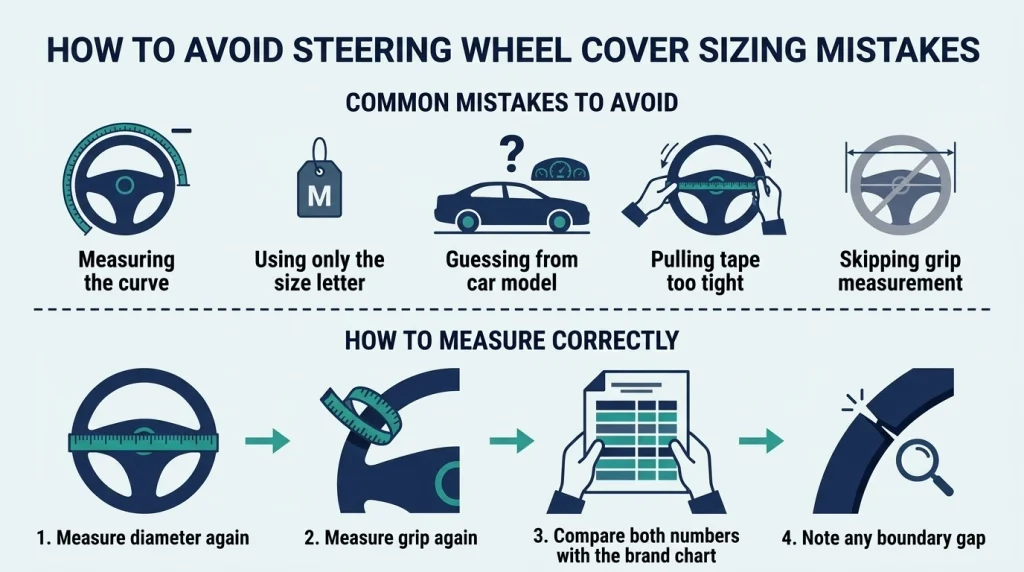
Most bad fits come from one skipped measurement, not a bad cover. These mistakes show up again and again in size questions.
- Measuring the curve: A curved tape reading runs long and points to a larger row.
- Using only the letter: A medium from one brand can match a large from another brand.
- Guessing from car model: Trim, model year, and wheel options can change wheel size.
- Pulling tape too tight: A squeezed grip reading hides rim thickness.
- Skipping grip: Diameter alone can miss a thick rim that needs more stretch.
How to double-check in two minutes
- Measure diameter again, straight across the center.
- Measure grip again, snug but not squeezed.
- Compare both numbers to the brand chart row by row.
- Note any boundary gap before you order.
You can also review general car care terms on Edmunds before you order. Keep the brand chart as your final check, since general terms do not replace its ranges.
Section takeaway: A two-minute recheck catches most size errors before they become a return.
Frequently Asked Questions About Steering Wheel Cover Sizes
What is the most common steering wheel cover size?
For many everyday cars, the medium range, around 14.5 to 15.5 inches in diameter, is a common starting point on general charts. Your own measurement still wins, because wheel options can differ by trim, model year, and package.
Do I need diameter, circumference, or both?
You need both numbers when the chart lists both. Diameter sets the overall size, and grip circumference checks whether the rim thickness fits the cover.
How do I measure without a flexible tape?
Wrap a piece of string around the rim, mark the loop, then lay it flat beside a ruler. For diameter, hold a straight ruler or stiff card across the center and read edge to edge.
What if the chart lists diameter only?
Use diameter as your first filter, then check the product notes for grip or thickness guidance. If no grip guidance appears, measure your grip and pick a cover with a stated stretch range that covers it.
Will a stretchy cover fix a wrong size?
Stretch can forgive a small gap, but it cannot fix a large size miss. A cover that is far too small may not seat evenly, and a far too large cover may slip.
Can a steering wheel cover be unsafe if it fits badly?
Yes, a loose cover can shift in your hands, and a forced cover can press on controls. Choose a snug, even fit, keep airbag and control areas clear, and check your owner’s manual if you are unsure.
The Bottom Line on Reading a Size Chart
Read the chart as a pair of numbers, not a single letter. Diameter gets you close, grip confirms the fit, and the brand chart has the final word.
For wider car context, see Car and Driver for general steering and interior coverage. Then measure once, compare both numbers, and order with confidence.

Daniel Brooks is an automotive writer and product researcher focused on car accessories, car tech, maintenance, and practical driving guides. At Plug-in Car World, he helps drivers make smarter automotive decisions through honest reviews and research-driven content.
