
Why Do Car Seats Expire? Lifespan, Safety Risks, and Replacement Guide
Quick Answer
Why do car seats expire? Child safety seats have manufacturer-defined lifespans because their materials, components, and safety designs can become less reliable over time. Many models last 6 to 10 years from manufacture, but the exact date depends on the seat. Always follow the manufacturer’s instructions and NHTSA car seat safety guidance.
Five Main Reasons Car Seats Expire
- Plastic aging: Temperature changes and sunlight can gradually affect the seat’s structural materials.
- Component wear: Harness straps, buckles, adjusters, and padding experience repeated use.
- Safety improvements: Standards, testing methods, and restraint designs evolve.
- Missing information: Older seats may lose safety labels, instructions, or replacement parts.
- Unknown history: Previous crashes, improper cleaning, or storage damage may create additional risks.
What Should You Do?
- Find the date: Inspect the manufacturer’s label, molded markings, or instruction manual.
- Check the history: Confirm the seat has no unresolved recalls, crash damage, or missing components.
- Replace when expired: Don’t keep using an expired seat, even when it looks clean and undamaged.
A child car seat can look almost new after years of use. That doesn’t automatically mean it’s still suitable for protecting a child during a collision.
When I inspect a child restraint, I start with its manufacturing label rather than its fabric cover. Here’s why that small label matters, how expiration works, and when replacement becomes necessary.
In This Guide
Why Do Child Car Seats Have Expiration Dates?
Car seats have expiration dates because manufacturers establish a useful life for their safety restraints. This period accounts for material aging, normal wear, evolving designs, and other product considerations.
Definition: A child car seat, also called a child restraint system, protects a child during vehicle travel. Its shell, harness, energy-absorbing materials, and installation components work together to manage crash forces.
1. Plastic and Protective Foam Can Age
A car seat’s plastic shell provides structural support, while certain foam components help manage impact energy. These materials experience different environmental conditions throughout the seat’s life.
Think about a vehicle parked outside during summer. Its interior may become extremely hot, then cool significantly overnight or during winter.
- Temperature cycling: Repeated heating and cooling can affect material properties over time.
- Sunlight: Ultraviolet exposure can contribute to the aging of certain plastics.
- Physical stress: Transporting, installing, and removing seats can produce wear.
- Storage conditions: Poor storage may introduce additional material damage or contamination.
A seat does not suddenly become brittle at midnight on its expiration date. Instead, the date marks the end of the manufacturer’s specified useful-life period.
2. Harness Straps, Buckles, and Adjusters Experience Wear
Children are buckled into their seats repeatedly. Over several years, the harness system can experience significant use.
Food, drinks, dirt, and improper cleaning methods can also affect components. That matters because the harness must function correctly during a collision.
- Harness webbing: Inspect for cuts, fraying, or other damage described in the manual.
- Buckles: Check that they latch and release according to manufacturer instructions.
- Harness adjusters: Confirm that adjustment mechanisms work correctly.
- Padding and covers: Look for deterioration and use only manufacturer-approved replacements.
Never use aggressive cleaning chemicals or soak harness straps unless the manufacturer explicitly permits that method. Cleaning mistakes can create safety concerns before expiration.
3. Car Seat Safety Standards and Designs Evolve
Child restraint technology changes as manufacturers develop products and safety requirements evolve. Newer seats may offer different installation features, adjustments, or protective designs.
However, an older seat doesn’t become unsafe simply because a newer model exists. The relevant question is whether your seat remains within its approved useful life and meets applicable requirements.
4. Replacement Parts and Instructions May Disappear
Manufacturers may eventually discontinue parts or support for older models. Missing instructions can also make proper installation more difficult.
Even a physically intact seat becomes unsuitable if a necessary component is missing and no approved replacement is available. Never substitute homemade parts or unapproved accessories.
Section Takeaway: Expiration reflects several long-term safety considerations, not just visible wear. A spotless fabric cover cannot establish that a seat remains suitable for use.
How Long Do Car Seats Last Before Expiring?
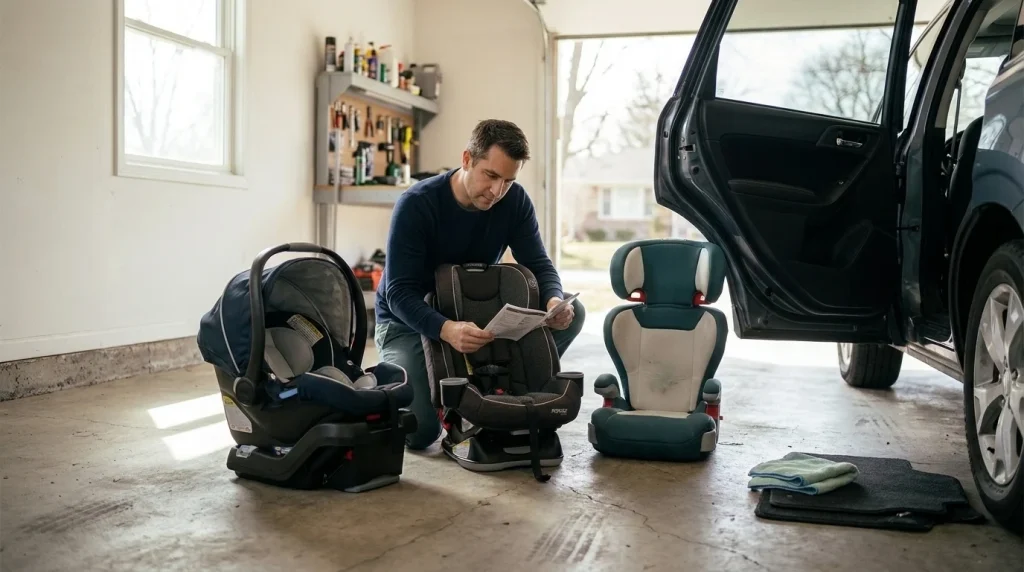
Many child car seats have useful lives of approximately 6 to 10 years. However, some models fall outside that range, so the manufacturer’s instructions always take priority.
There is no single expiration period that applies to every infant seat, convertible seat, and booster. Even models from the same brand can have different limits.
Car Seat Lifespan Comparison by Manufacturer
Published guidance from Graco and Britax provides useful examples. These are manufacturer-specific periods, not universal rules.
| Manufacturer | Seat Category | Published Useful Life |
|---|---|---|
| Britax | Various models | Generally 6–10 years |
| Graco | Seats with plastic-reinforced belt paths | 7 years |
| Graco | Seats with steel-reinforced belt paths | 10 years |
| Graco | Belt-positioning boosters | 10 years |
Note: These figures reflect published manufacturer guidance reviewed in 2026. Verify the exact model, manufacture date, and manual before calculating expiration.
Does Car Seat Expiration Start When You Buy It?
For typical U.S. models, expiration is calculated from the date of manufacture, not the purchase date. A seat may already be several months old when you buy it.
Here’s a simple example of a seat with a seven-year useful life:
- Manufactured: March 15, 2019
- Manufacturer-specified lifespan: 7 years
- Calculated expiration: March 15, 2026
- Purchased: June 2020
Buying that seat in June 2020 would not extend its expiration to June 2027. Always calculate according to the instructions for your specific model.
Do Infant Seats, Convertible Seats, and Boosters Expire Differently?
Yes, different restraint designs may have different lifespans. However, the product category alone cannot tell you the exact expiration date.
- Infant-only seats: Check the carrier and any detachable base.
- Convertible seats: Follow the stated useful life for the complete seat.
- All-in-one seats: Verify the manufacturer’s limit despite their multiple configurations.
- Booster seats: Check expiration even when there is no built-in harness.
Section Takeaway: Use the manufacturer’s specified lifespan rather than a general six-year rule. The manufacture date is usually the starting point for calculating expiration.
Where Can You Find the Car Seat Expiration Date?
Most manufacturers place the manufacture date or expiration information on a permanent label or marking. Common locations include the back, bottom, or side of the plastic shell.
Here’s the inspection process I recommend before reusing an older child restraint.
Step 1: Find the Manufacturer’s Label
Remove the seat from the vehicle if necessary, following the manual. Inspect its underside and outer shell carefully.
Look for these details:
- Date of manufacture: Sometimes abbreviated as DOM.
- Model number: Identifies the specific restraint design.
- Serial number: May help the manufacturer confirm product details.
- Expiration marking: Some models print a specific date or year.
Step 2: Check the Plastic Shell and Manual
Some manufacturers mold the expiration information into the plastic rather than printing it on a sticker. Others state the useful life only in the instruction manual.
Look for wording such as “Do not use this child restraint after” followed by a date or number of years.
Pro tip: Photograph the manufacture label and save a copy of the manual. You’ll have the exact model details available for future safety checks.
Step 3: Contact the Manufacturer If Information Is Missing
Don’t guess an expiration date from the seat’s appearance. Contact the manufacturer with whatever model details you can identify.
If the seat cannot be identified reliably, don’t use it. Without accurate information, you may be unable to confirm its expiration or recall status.
Can a Car Seat Become Unsafe Before Its Expiration Date?
Yes. A child restraint can become unsuitable before expiration because of crash involvement, damaged parts, unresolved recalls, or improper use.
Think of the expiration date as one part of a larger safety checklist. It cannot replace a condition inspection and complete product-history review.
What Happens If the Seat Was Involved in a Crash?
Crash history matters because damage isn’t always visible. A seat may appear normal while its protective components have experienced significant forces.
According to NHTSA’s car seat replacement guidance, seats should be replaced after moderate or severe crashes. Replacement may not be necessary after a minor crash, provided the manufacturer allows continued use.
NHTSA defines a minor crash as one meeting all five conditions:
- The vehicle could be driven away afterward.
- The vehicle door nearest the car seat was undamaged.
- No vehicle occupants were injured.
- No airbags deployed.
- The car seat has no visible damage.
If any condition isn’t met, the crash does not qualify as minor under these criteria. Always follow the car seat manufacturer’s replacement instructions, which may be stricter.
Pro tip: Consult the manufacturer or a certified child passenger safety technician if you’re uncertain about crash-related replacement.
Can Recalled Car Seats Still Be Used?
A recall means a manufacturer or safety regulator has identified a problem requiring corrective action. Not every recall automatically requires replacing the entire seat.
Use the NHTSA recall lookup to check your seat’s make and model. Follow the recall notice and contact the manufacturer about the required remedy.
Are Secondhand Car Seats Safe?
A used car seat may be suitable when its history is fully known and it passes the relevant safety checks. An unknown crash history is a serious reason to avoid one.
Before accepting a used seat, confirm the following:
- The seat is within its manufacturer-defined useful life.
- Its complete crash history is known.
- All original components or approved replacements are present.
- No prohibited modifications or cleaning methods have been used.
- Its model and manufacture labels are readable.
- It has no unresolved recalls or visible damage.
- The correct instructions are available.
Can Seat Covers or Cleaning Products Affect Safety?
Yes, particularly when products interfere with a harness or other safety components. A decorative cover is not a substitute for an approved child restraint cover.
Use manufacturer-approved covers and follow the manual’s cleaning instructions. Avoid aftermarket inserts, padding, or harness accessories unless the seat manufacturer approves them.
Section Takeaway: A seat may need replacement well before its printed expiration date. Always evaluate recalls, crash history, physical condition, and manufacturer instructions together.
What Should You Do With an Expired Car Seat?
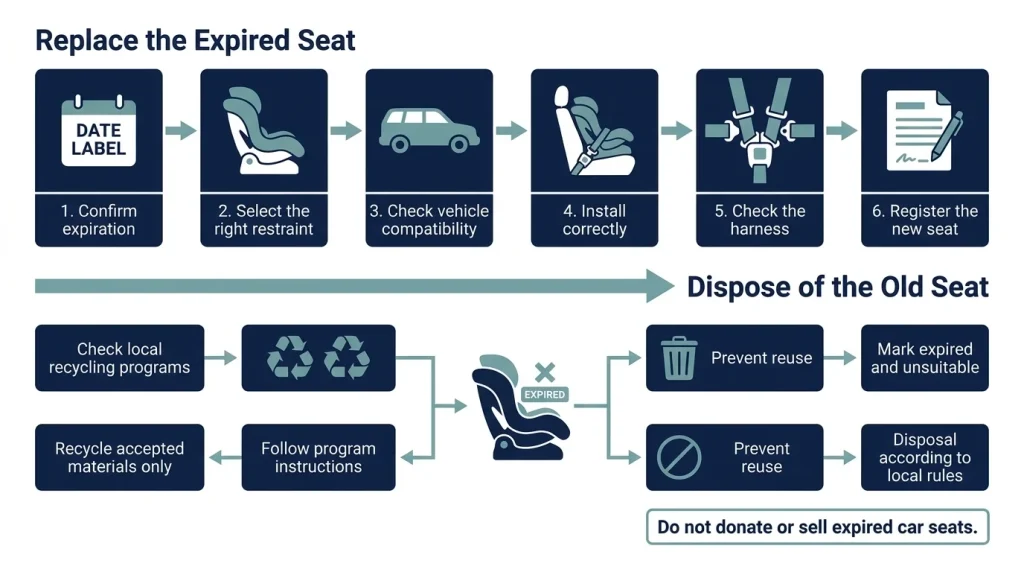
Stop using an expired child restraint and replace it with a suitable seat. Don’t continue using the expired model for occasional trips or as an emergency backup.
The safest replacement is one that fits the child, fits the vehicle, and can be installed correctly. Price alone does not determine safety.
How to Replace an Expired Car Seat
- Confirm expiration: Check the manufacturer label, manual, or customer support.
- Select the right restraint: Match the child’s height, weight, and developmental stage.
- Check vehicle compatibility: Review both the vehicle manual and car seat instructions.
- Install correctly: Follow the permitted seat belt or lower-anchor installation method.
- Check the harness: Adjust its position and tightness according to the manual.
- Register the new seat: Provide your information to the manufacturer for recall notifications.
Keep children rear-facing as long as their seat’s height and weight limits allow. Don’t move a child into the next restraint stage simply because an old seat expires.
Can You Donate or Sell an Expired Car Seat?
No. An expired safety restraint should not be passed to another family for child passenger use.
This includes selling it online or leaving it at a donation center. Someone else may mistake a clean-looking seat for a safe product.
How Should You Dispose of an Expired Seat?
Start by checking whether your area has a car seat recycling or trade-in program. Program requirements vary, and some locations accept only certain materials or models.
If no program accepts the seat, follow local waste-disposal rules and the manufacturer’s recommendations. Prevent the discarded restraint from being reused.
- Check recycling options: Ask about local car seat collection programs.
- Follow program instructions: Some recycling programs require seats to remain intact.
- Disable unsafe discarded seats: When appropriate, cut the harness after permanently removing the seat from service.
- Mark clearly: Label the discarded seat as expired and unsuitable for use.
- Separate materials: Recycle components only when local facilities accept them.
Don’t assume every plastic car seat shell belongs in household recycling. Material types and local recycling rules differ.
Garage reminder: Before storing a seat for a younger sibling, record its manufacture date and remaining useful life. Storage does not pause a manufacturer’s expiration clock.
Frequently Asked Questions About Car Seat Expiration
1. Do all car seats expire after six years?
No. Six years is one possible manufacturer-defined useful life, but many models have longer periods. Some last seven, eight, or ten years, and manufacturer instructions can specify other limits. Always check the exact model rather than assuming every child restraint expires after six years.
2. Are expired car seats dangerous even when they look new?
An expired seat may show no visible damage, but appearance cannot confirm its continued protective performance. Manufacturers establish useful-life limits partly because of aging and other safety considerations. Replace an expired seat rather than relying on how clean or sturdy it feels.
3. Can I use a car seat one month after it expires?
You should not use a seat after its manufacturer’s expiration date. There is no established universal grace period that makes an expired seat acceptable for another month. Arrange a suitable replacement before transporting your child.
4. Does a car seat expire if it has never been used?
Yes, a seat can reach its expiration date while still unused. Many manufacturers calculate useful life from the manufacture date, so remaining in its original box does not restart the clock. Check the specific manufacturer’s instructions before using old stock.
5. Do car seat bases expire separately?
Detachable infant car seat bases may have their own labels and manufacturer instructions. Confirm the applicable expiration details for both the infant carrier and its base. Never assume an older base remains suitable simply because a compatible-looking carrier is newer.
6. Is it illegal to use an expired car seat?
Child restraint laws differ by jurisdiction, and expiration is not a universal standalone legal rule. Manufacturers nevertheless direct owners to stop using seats beyond their specified useful life. Follow those instructions regardless of whether your local traffic laws explicitly mention expiration.
7. Can I extend a car seat’s lifespan by replacing its cover?
No. Changing the fabric cover cannot renew the shell, harness components, or manufacturer-defined useful life. Even a complete cleaning and fresh padding won’t extend the expiration date. Use only manufacturer-approved replacement parts while the seat remains within its approved lifespan.
Final Takeaway: Check Your Car Seat’s Expiration Date
So, why do car seats expire? Manufacturers set useful-life limits because safety restraints experience material aging, component wear, and changing product requirements.
The important point is simple: A clean-looking car seat is not necessarily a safe car seat. Its age, crash history, condition, recall status, and correct installation all matter.
Before your child’s next ride, find the manufacture label and check the manual. If the seat has expired, replace it with an appropriate restraint and dispose of the old one responsibly.
Your next step: Check the manufacture date today, record the expiration date, and keep the information with your vehicle documents.

Daniel Brooks is an automotive writer and product researcher focused on car accessories, car tech, maintenance, and practical driving guides. At Plug-in Car World, he helps drivers make smarter automotive decisions through honest reviews and research-driven content.
