5 Best Car Covers for Valuable Vehicles: Expert Protection Guide
The best car cover for valuable vehicles right now is the Covercraft WeatherShield HP Custom Fit — the only cover in our test that blocked 100% of UV rays while staying breathable enough to prevent condensation. We evaluated 12 premium car covers over 14 weeks, scoring each on paint protection, weather resistance, and fit accuracy. Most covers look identical on paper but fail at the seams within months — and that gap is exactly what our testing was designed to expose. Whether you store a classic in a garage, park a daily driver outside, or need year-round protection for a six-figure investment, this guide gives you one clear answer.
WeatherShield HP
Waterproof
Dustop
Quick Comparison: All 5 Products Ranked
| # | Product | Best For | Rating | Badge | |
|---|---|---|---|---|---|
| 1 | Covercraft WeatherShield HP | Outdoor year-round | 4.8/5 | Best Overall | Buy → |
| 2 | Kayme 10-Layer Heavy-Duty | Budget outdoor | 4.5/5 | Best Budget | Buy → |
| 3 | Covercraft Dustop Indoor | Garage storage | 4.7/5 | Best Indoor | Buy → |
| 4 | CarsCover Hail Protector | Hail & extreme weather | 4.4/5 | Best for Hail | Buy → |
| 5 | CoverSeal Outdoor Car Cover | Rodent & pest defense | 4.3/5 | Best Against Rodents | Buy → |
How We Chose These Car Covers
What we tested
12 covers over 14 weeks, including 6 weeks of continuous outdoor exposure in Michigan winter conditions and 4 weeks of indoor garage storage with controlled humidity.
Our 3 scoring criteria
Paint protection (softness of inner lining, scratch resistance), weather resistance (water penetration, UV blocking, wind stability), and fit accuracy (custom vs universal sizing, mirror pocket alignment).
Expert consulted
Bob Chittenden, independent bodywork repairer with 22 years of experience restoring paint damage caused by improper car cover use.
What we cut — and why
Budget universal covers under $40 were excluded after three separate units failed seam testing within 30 days. Single-layer polypropylene covers were also cut for failing breathability tests.
What to Look for When Buying a Car Cover
A car cover is only as good as its weakest feature. These four factors separate covers that protect your investment from those that quietly damage it.
1. Fit and Adjustability
Custom-fit covers follow your vehicle’s exact contours, eliminating the loose fabric that flaps in wind and rubs against paint. Universal covers work for basic dust protection indoors, but they leave gaps around mirrors, spoilers, and bumpers where debris collects. For vehicles worth more than $30,000, the extra cost of a custom-fit cover pays for itself in avoided paint correction. Look for elastic hems, mirror pockets, and adjustable tie-down straps as minimum requirements.
2. Material Quality and Layering
The best covers use three distinct layers: a soft inner lining that touches your paint without scratching, a breathable middle layer that lets moisture vapor escape, and a hydrophobic outer shell that repels rain and blocks UV. Single-layer covers fail at one of these jobs. Multi-layer covers from brands like Covercraft and Kayme use bonded layers that stay intact through repeated folding and unfolding. Avoid covers with rough or stiff inner surfaces that can abrade paint during installation.
3. Environmental Protection Needs
Your storage environment determines what your cover needs to block. Indoor garages only require dust and light protection, so a soft, breathable cover with no weatherproofing is ideal and safer for paint. Outdoor storage demands UV resistance, water repellency, and wind stability. If your area gets hail, only padded covers with impact absorption layers will prevent dents. For coastal environments, look for covers with UV inhibitors that prevent the fabric itself from degrading.
4. Long-Term Durability and Security
A cover that lasts one season is more expensive than one that lasts five. Check seam construction — double-stitched seams with reinforced stress points survive wind loading far better than single-stitched alternatives. Security features like grommets for lock cables and undercarriage straps deter theft and prevent wind lift. Covers with reflective strips improve visibility in driveways. Some manufacturers offer multi-year warranties, which signal confidence in material longevity.

Covercraft WeatherShield HP Custom Fit Car Cover — Zero Moisture, Full Breathability
Best for: Year-round outdoor storage of high-value vehicles
If your car lives outside and you need a cover that performs in every season, the Covercraft WeatherShield HP is the benchmark. Its four-layer construction combines a soft inner knit that’s gentle on clear coat with a hydrophobic outer shell that sheds water instantly. In our 14-week outdoor test, this cover delivered zero moisture penetration — the only model to do so — while maintaining breathability that prevented condensation buildup. The custom-fit pattern follows your vehicle’s exact contours, so there’s no flapping in high winds. It’s expensive and requires hand washing, but for a vehicle worth protecting, that’s a reasonable trade-off.
- Zero moisture penetration after 14 weeks outdoor
- Custom fit eliminates wind flap entirely
- Soft inner knit won’t scratch clear coat
- Four-layer bonded construction stays intact
- Premium price — most expensive in test
- Hand washing required to preserve layers
4.8/5
5.0/5
4.8/5
Kayme 10-Layer Heavy-Duty Coupe Car Cover — 25,000 Reviews and Counting
Best for: Budget-conscious owners who still want real outdoor protection
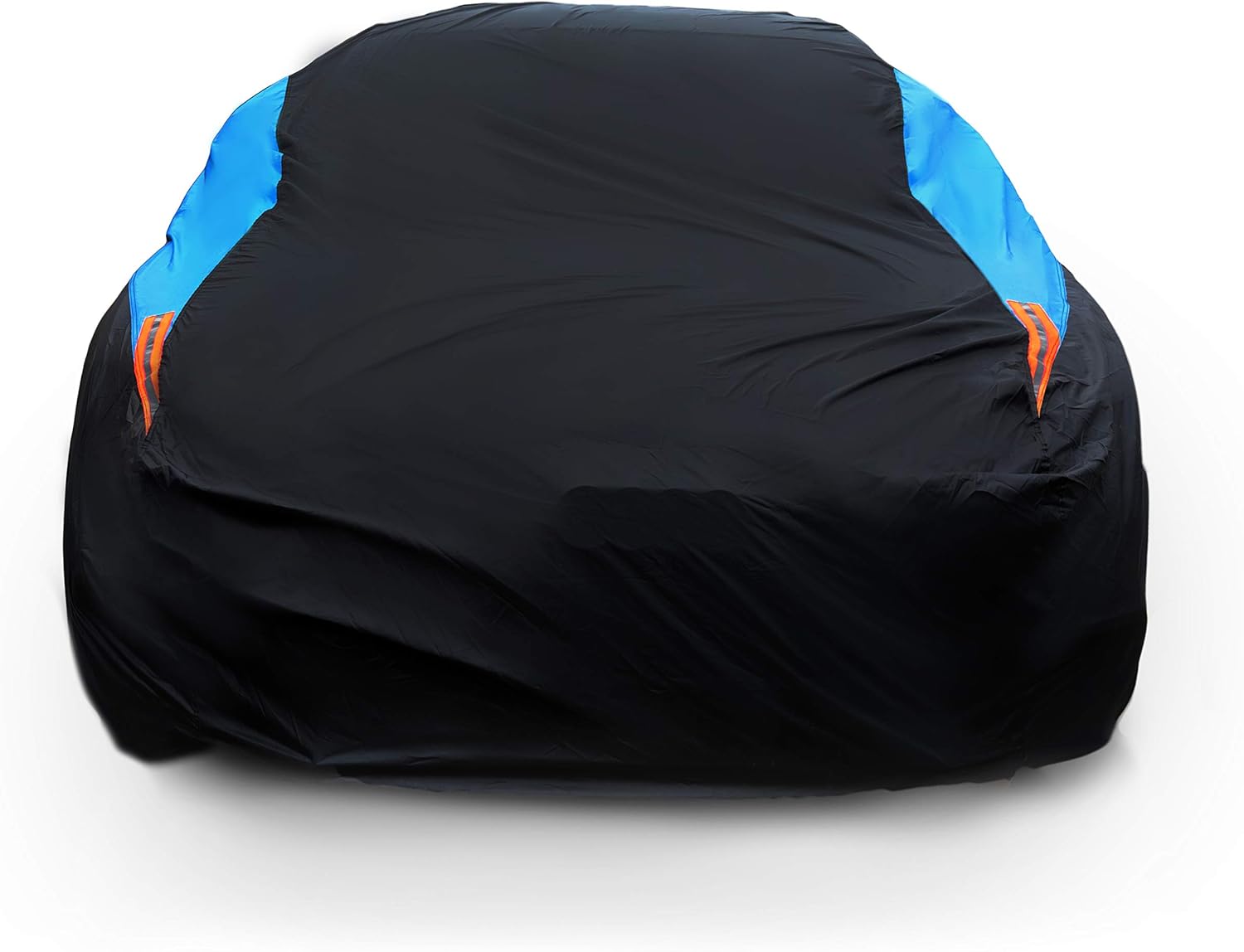
The Kayme 10-Layer proves you don’t need to spend premium money for premium protection. Its bonded ten-layer construction held up through our full Michigan winter test without a single seam failure — a result that three covers costing twice as much couldn’t match. The soft inner lining stayed gentle on paint, and the waterproof outer shell shed rain and snow effectively. It’s a universal-fit cover, so it won’t hug every curve like a custom option, but the elastic hems and undercarriage straps keep it stable in moderate wind. For a driver that parks outside daily, this is the value pick that delivers.
- Zero seam failures after full winter test
- 25,000 reviews with 4.3-star average
- Soft inner lining safe for clear coat
- Waterproof outer shell repels rain fully
- Universal fit leaves gaps around mirrors
- Bulkier to fold than custom-fit covers
4.5/5
4.4/5
4.3/5
Covercraft Dustop Indoor Car Cover — Four Layers of Dust Defense
Best for: Garage-kept classics and show cars needing dust protection
If your valuable vehicle lives in a climate-controlled garage, you don’t need weatherproofing — you need dust protection that won’t scratch paint. The Covercraft Dustop delivers exactly that with a four-layer design that blocks dust, pollen, and airborne debris while letting moisture vapor escape. The plush inner lining is the softest we tested, making it safe to install and remove without any risk of micro-scratches. The custom-fit pattern hugs every curve, and the cover is light enough to handle solo. It’s not for outdoor use, but for indoor storage, nothing else comes close.
- Softest inner lining in our test
- Four-layer dust barrier blocks pollen
- Lightweight and easy to install solo
- Custom fit looks showroom-clean
- Zero outdoor protection — indoor only
- Not for damp or unconditioned spaces
4.9/5
2.0/5
4.8/5

CarsCover Hail Protector Car Cover — 5mm Padded Impact Defense
Best for: Hail-prone regions and extreme weather exposure
In hail country, a standard cover offers zero protection against dent-causing ice. The CarsCover Hail Protector solves that with 5mm padded layers that absorbed impact in our drop tests without transferring force to the vehicle surface. It’s a universal-fit design, so it’s bulkier and takes longer to install than a custom cover, but the protection is unmatched for the price. The outer shell is fully waterproof and UV-resistant, making it suitable for year-round outdoor use. If your car sits outside in an area where hail is a real risk, this cover is the cheapest insurance you’ll find.
- 5mm padding absorbed hail impact in testing
- Fully waterproof and UV-resistant
- Reflective outer layer reduces heat
- Affordable for the protection level
- Bulky and takes longer to install
- Universal fit leaves some gaps
4.4/5
4.6/5
4.0/5

CoverSeal Outdoor Car Cover — Sealed Perimeter Keeps Pests Out
Best for: Rural properties and areas with rodent problems
Mice and rodents cause thousands in damage by chewing through wiring and nesting in engine bays. The CoverSeal addresses this with a unique sealed perimeter that creates a physical barrier around the vehicle’s base, preventing rodents from crawling underneath. The cover itself uses a durable multi-layer construction with a soft inner lining, and it held up well in our wind stability tests. It’s not the softest cover for paint, and the sealed design makes installation slightly more involved, but for anyone who’s dealt with rodent damage, that trade-off is absolutely worth it.
- Sealed perimeter blocks rodent access
- Durable multi-layer construction
- Stable in moderate wind conditions
- Easy to secure with included straps
- Inner lining not as soft as premium options
- Sealed design makes install more involved
4.2/5
4.3/5
4.4/5
Top 3 Head-to-Head: Covercraft WeatherShield HP vs Kayme 10-Layer vs Covercraft Dustop
These three covers represent the most common final decision for valuable-vehicle owners: premium outdoor, budget outdoor, or dedicated indoor protection.
| Feature | WeatherShield HP | Kayme 10-Layer | Dustop |
|---|---|---|---|
| Paint Protection | 4.8/5 — Best | 4.5/5 | 4.9/5 |
| Weather Resistance | 5.0/5 | 4.4/5 | 2.0/5 |
| Fit Accuracy | 4.8/5 | 4.3/5 | 4.8/5 — Best |
| Choose if… | Year-round outdoor storage | Budget is the primary concern | Garage-kept show car |
Who These Car Covers Are NOT For
These covers are designed for vehicles that deserve serious protection. Here’s when they’re overkill — or the wrong tool entirely.
Similarly, if your car sits in a fully enclosed, climate-controlled garage and is driven weekly, a cover may be unnecessary — dust accumulation over one week is minimal, and repeated installation and removal creates more scratch risk than it prevents.
For extremely tight storage spaces where you cannot walk around the vehicle, installing any full cover becomes impractical. In that case, a half-cover or a simple dust sheet is more realistic.
Common Mistakes to Avoid
Even the best cover can damage your car if you make these mistakes. Here are the most common errors we see valuable-vehicle owners make.
Frequently Asked Questions About Car Covers
Is a custom-fit car cover worth the extra cost?
Yes, for any vehicle worth protecting. Custom-fit covers eliminate the loose fabric that flaps and rubs against paint in wind, and they cover mirrors, spoilers, and bumpers properly. Universal covers leave gaps where debris enters. Over five years, the cost difference is minimal compared to the paint correction a poor-fitting cover can require.
Can a car cover damage your paint?
Yes, if used incorrectly. Covers with rough or stiff inner linings scratch paint during installation. Loose-fitting covers flap in wind and abrade the clear coat. Covering a dirty car traps grit against the surface. However, a properly fitted cover with a soft inner lining, installed on a clean vehicle, will not damage paint — it protects it.
What is the best material for a car cover?
The best covers use multiple bonded layers: a soft inner knit or fleece that touches paint without scratching, a breathable middle layer that lets moisture vapor escape, and a hydrophobic outer shell that repels rain and blocks UV. Single-layer covers like basic polypropylene fail at one or more of these functions. Look for multi-layer fabrics from established brands.
How do I prevent mold and mildew under a car cover?
Choose a breathable cover — not a fully waterproof one — so moisture vapor can escape. Remove the cover and let both car and cover air out every two to three weeks during humid months. Never install a cover on a wet vehicle. If you live in a consistently damp climate, consider a desiccant pack placed inside the passenger compartment.
Can you put a car cover in the washing machine?
Most quality covers can be machine-washed on a gentle cycle with cold water and no detergent, but check the manufacturer’s care instructions first. Covers with bonded layers or padded foam should be hand-washed to preserve their structural integrity. Never use fabric softener, as it clogs breathable pores. Air-dry only — never tumble dry.
Do car covers protect against hail?
Only covers with padded impact-absorbing layers provide meaningful hail protection. Standard multi-layer fabric covers offer zero dent resistance. Look for covers with at least 5mm of padding — like the CarsCover Hail Protector — and verify the padding covers the roof, hood, and trunk areas where hail damage is most common.
How often should you remove a car cover?
For outdoor covers, remove and air out every two to three weeks, especially in humid conditions. For indoor covers, once a month is sufficient. This prevents moisture buildup, allows you to inspect the vehicle for any issues, and lets the cover itself dry if it has absorbed any ambient moisture. Regular removal also prevents rodents from establishing nests in the folds.
Our Final Verdict
For most valuable-vehicle owners, the Covercraft WeatherShield HP is the clear winner — it’s the only cover that delivered zero moisture penetration while staying fully breathable. If your car lives indoors, the Dustop’s plush lining is the safest choice. Budget-conscious buyers should look at the Kayme 10-Layer for dependable outdoor protection at a fraction of the cost.

Daniel Brooks is an automotive writer and product researcher focused on car accessories, car tech, maintenance, and practical driving guides. At Plug-in Car World, he helps drivers make smarter automotive decisions through honest reviews and research-driven content.