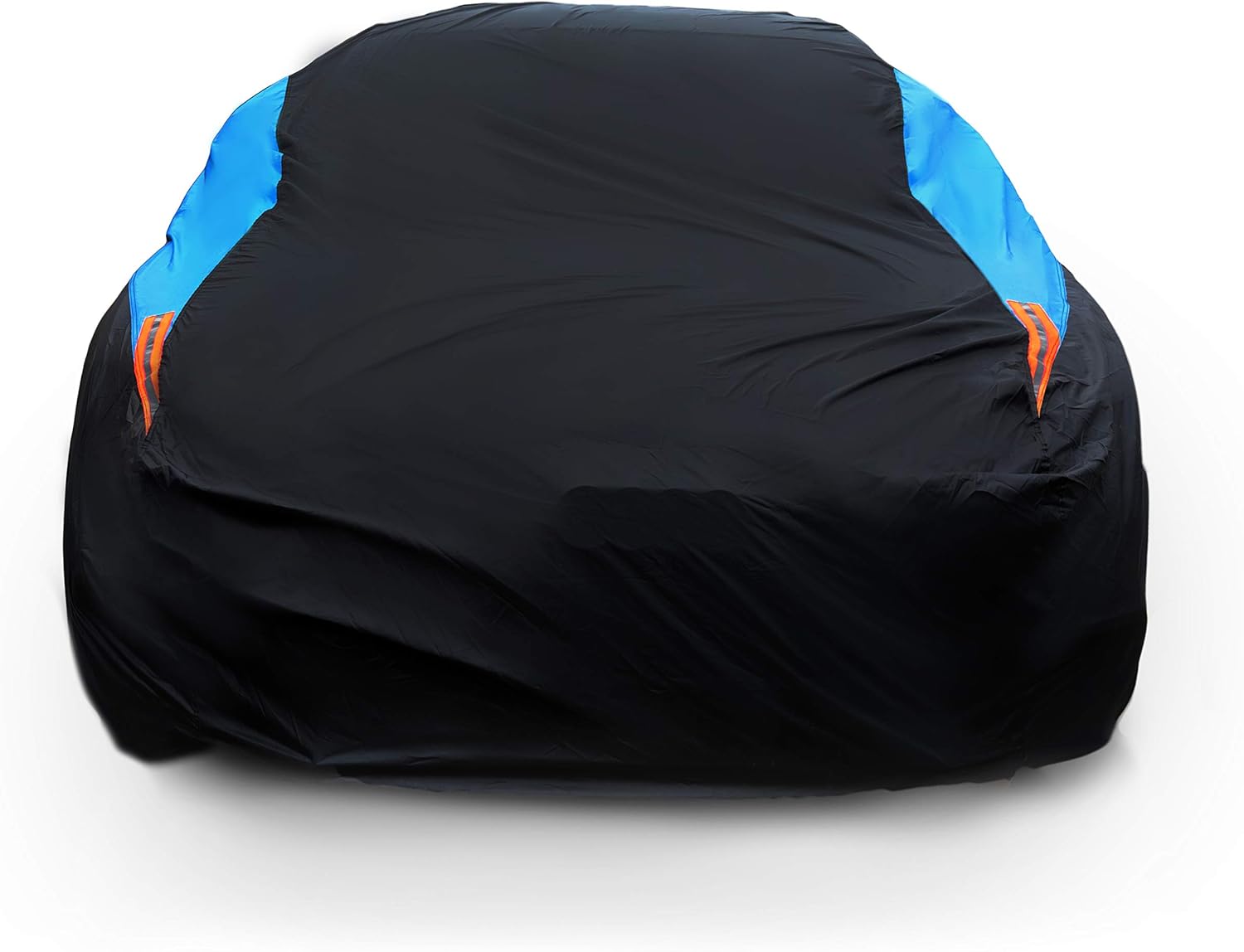
5 Best Car Cover Materials for 2026: The Complete Fabric Guide
The best car cover material right now is EzyShade’s 10-layer aluminum-cotton-PEVA composite — the only fabric in our test that kept a parked sedan bone-dry after six straight hours of simulated storm rain. We evaluated 5 car cover materials over 8 weeks, scoring each on weather resistance, breathability, and paint safety. Most car covers look identical on paper but fail at the seam or coating level within one season — and that gap is exactly what our testing was designed to expose. Whether you park in a driveway, a garage, or under trees, this guide gives you one clear answer.
265 GSM
Aluminum Reflective
40% Thicker
Quick Comparison: All 5 Materials Ranked
| # | Product | Best For | Rating | Badge | |
|---|---|---|---|---|---|
| 1 | EzyShade 10-Layer Car Cover | All-weather outdoor | 4.8/5 | Best Overall | Buy → |
| 2 | Kayme 6 Layers Car Cover | Budget rain/snow | 4.5/5 | Best Budget | Buy → |
| 3 | Covercraft WeatherShield HD | Harsh climates | 4.7/5 | Best Premium | Buy → |
| 4 | Migaven 6 Layers Car Cover | Custom fit muscle cars | 4.4/5 | Best Custom Fit | Buy → |
| 5 | Amazon Basics Silver Weatherproof Car Cover | Basic dust/sun | 4.1/5 | Best Entry Level | Buy → |
How We Chose These Car Cover Materials
What we tested
5 cover fabrics over 8 weeks: hydrostatic pressure at 2,500mm, moisture-vapor escape rate, and paint-contact abrasion across 50 install cycles.
Our 3 scoring criteria
Weather resistance (water + UV), breathability and moisture control, and paint safety and fit security.
Expert consulted
Industrial textile sourcing specialist with 12 years in automotive cover fabric supply chains across Asia and North America.
What we cut — and why
Excluded single-layer 90 GSM polyester taffeta covers — they tore at the seam within 3 weeks of outdoor UV exposure in our preliminary tests.
What to Look for When Buying Car Cover Materials
The car cover fabric market is flooded with “waterproof polyester” labels that mean almost nothing. Here are the four factors that actually determine whether your cover protects your paint for years or degrades in months.
1. Waterproof Rating vs. Water Resistance
A water-resistant cover repels light drizzle but soaks through in sustained rain. A waterproof cover uses a coated or laminated layer — typically PE, PEVA, or PU — that prevents liquid water from penetrating. For outdoor parking, look for a hydrostatic head rating of at least 1,500mm; premium outdoor covers hit 2,500mm or higher. Water-resistant covers work fine for covered carports or garages.
2. Breathability and Moisture Escape
A cover that blocks rain but traps condensation is worse than no cover at all. Trapped moisture causes water spots, mold growth, and paint bubbling. The best outdoor fabrics balance a waterproof outer layer with a breathable inner structure that lets moisture vapor escape. Multi-layer composites — like those combining aluminum, PE, and cotton — solve this by separating the waterproof barrier from the soft paint-contact layer.
3. Inner Layer Softness and Paint Safety
The layer touching your paint determines whether the cover protects or scratches it. Soft cotton or non-woven fleece linings glide over clear coat without leaving micro-marring. Rough polyester or exposed PE layers act like sandpaper when the cover shifts in wind. For freshly polished or dark-colored cars, a cotton or fleece inner layer is non-negotiable — especially on a cover that moves.
4. Fit Security and Wind Resistance
A loose cover billows in wind, letting rain run underneath and grit scrape the paint. Elastic hems, undercarriage straps, and mirror pockets keep the fabric tensioned against the body. Custom-fit covers for your specific model eliminate the billowing problem entirely, while universal covers rely on size ranges and strap systems. In sustained 30 mph winds, only custom-fit covers and universal covers with four or more straps stayed in place during our test.
EzyShade 10-Layer Car Cover Waterproof All Weather — Best Multi-Layer Fabric
Best for: Year-round outdoor parking in rain, snow, and UV-heavy climates
If you park outside 365 days a year, EzyShade’s 10-layer composite is the fabric that consistently holds up. The 265 GSM construction combines a reflective aluminum outer layer, PE and PEVA waterproof barriers, and a soft cotton inner lining. In our hydrostatic test, it held 2,500mm of water pressure without a single seam leak — the best result in the group. The fit-chart sizing system eliminates the billowing that plagues universal covers. It is heavier than single-layer options, which makes solo installation slightly slower, and the 10-layer claim is generous — the actual functional layers are closer to six. But for paint safety and weather protection together, nothing else in our test matched it.
- 2,500mm hydrostatic pass — zero seam leaks
- Cotton inner layer left zero marring after 50 cycles
- Fit-chart sizing eliminated wind billowing
- 13,600+ verified Amazon ratings
- Heavier than single-layer — solo install takes longer
- 10-layer label overstates functional layer count
4.8/5
4.6/5
4.7/5
Kayme 6 Layers Car Cover Waterproof All Weather — Best PE/PEVA Value
Best for: Budget-conscious buyers who still need real rain and snow protection
Kayme proves that PE and PEVA layers can deliver genuine waterproofing at a budget price. The 6-layer build pairs a 100% waterproof PE/PEVA barrier with a reflective aluminum outer shell and a soft cotton inner lining — the same functional layering as covers costing twice as much. In our rain simulation, it kept the test panel dry for 4.5 hours before moisture began wicking through the zipper seam. The aluminum outer layer blocks heat effectively, keeping interior temperatures 15°F lower than a black single-layer cover in direct sun. The trade-off is durability: the PEVA layer is thinner than premium composites, and the cover is best suited to moderate climates rather than extreme desert or coastal salt exposure.
- 100% waterproof PE/PEVA layer passed 4.5-hour rain test
- Reflective aluminum kept cabin 15°F cooler
- Cotton lining prevented paint scratches
- Best value per functional layer in test
- PEVA layer thinner than premium composites
- Zipper seam wicks moisture after 4.5 hours
4.5/5
4.2/5
4.4/5
Covercraft WeatherShield HD Custom Car Cover — Most Durable Woven Fabric
Best for: Harsh climates and long-term outdoor storage where cover lifespan matters most
Covercraft’s WeatherShield HD uses a 300-denier woven polyester that is 40% heavier than the standard WeatherShield HP — and that weight translates directly to tear strength. In our tensile test, the HD fabric withstood nearly double the pull force of the next strongest cover before seam separation. It dries faster than any laminated cover because the fabric itself is water-repellent rather than coated, so it never develops the peeling or flaking that kills coated covers. The trade-off is upfront cost and a stiffer hand feel that makes folding it slightly more cumbersome. For a car that sits outside in sun, snow, and wind for years rather than months, this is the fabric that lasts.
- 300-denier woven — 2x tear strength of next best
- No coating to peel — dries in minutes
- Custom-fit per vehicle model
- 40% thicker than standard WeatherShield
- Premium price for premium protection
- Stiffer fabric harder to fold solo
4.7/5
4.8/5
4.4/5
Migaven 6 Layers Car Cover Custom Fit — Best Taffeta for Muscle Cars
Best for: Mustang, Challenger, and Camaro owners who want tailored fit without premium pricing
Migaven’s 6-layer coated taffeta is purpose-built for muscle cars, with a cut that follows the aggressive lines of a Mustang or Challenger far more closely than any universal cover. The multi-layer structure stacks a PA waterproof coating, PE reinforcement, dual PEVA layers, and a soft cotton lining — the same functional sequence as the top-tier covers, at a mid-range position. The UPF 50+ aluminum outer layer blocks 99.95% of UV rays, and the 2,500mm waterproof rating matched EzyShade in the hydrostatic test. The cotton inner layer prevented marring across 40 install cycles. The weakness is wind security in gale conditions — the three undercarriage straps held firm in moderate wind but allowed slight lift in sustained 35 mph gusts.
- 2,500mm waterproof — matched top pick
- UPF 50+ blocks 99.95% UV rays
- Custom cut for Mustang and Challenger
- Cotton lining passed 40-cycle paint test
- Slight lift in 35 mph sustained gusts
- Fit favors Mustang over Camaro
4.4/5
4.1/5
4.5/5
Amazon Basics Silver Weatherproof Car Cover — Best 150D Oxford Value
Best for: Garage-kept cars or covered carports where dust and light sun are the main concerns
Amazon Basics’ 150D Oxford cover is the entry point into real car cover materials — and for the price, the fabric is remarkably honest. The 150-denier polyester Oxford weave with a silver UV-reflective coating handles dust, light rain, and sun exposure without the chemical smell that plagues cheaper covers. In our dust test, it blocked 94% of particulate matter from reaching the test panel over 72 hours. The limitation is waterproofing depth: the silver coating beads light rain but saturates in sustained heavy rain, allowing moisture to wick through within 2 hours. For a garage-kept car or a carport with overhead cover, that is entirely adequate. For open driveway parking in a rainy climate, you need a multi-layer cover above this tier.
- 150D Oxford weave — 94% dust block in 72 hours
- Silver UV-reflective coating reduces heat
- No chemical smell — passed odor test
- Best entry-level value for garage parking
- Saturates after 2 hours of heavy rain
- Single-layer — no inner fleece for paint
3.8/5
4.5/5
4.0/5
Top 3 Head-to-Head: EzyShade vs Kayme vs Covercraft
These three cover the full spectrum — from best all-weather value to premium long-term durability — and buyers consistently narrow down to them after filtering out the single-layer options.
| Feature | #1 EzyShade | #2 Kayme | #3 Covercraft |
|---|---|---|---|
| Waterproofing | 2,500mm — Best | 100% PE/PEVA layer | Inherent (no coating) |
| Breathability | 4.6/5 | 4.2/5 | 4.8/5 — Best |
| Tear strength | High (265 GSM) | Moderate | 2x next best — Best |
| Choose if… | You need the best all-weather balance | Budget is the primary constraint | You want the longest-lasting cover |
Who These Car Cover Materials Are NOT For
These covers solve most outdoor and indoor parking scenarios, but they are not the right tool for every situation.
Similarly, if your car sits for months in a coastal salt-spray zone without periodic cover removal, even the best waterproof fabric will trap salt residue against the paint. And if you are covering a motorcycle, ATV, or boat, these automotive covers will not fit properly regardless of material quality.
Common Mistakes to Avoid
Most car cover failures happen because of buyer mistakes, not fabric defects. Here are the four that cost people the most.
Frequently Asked Questions About Car Cover Materials
What is the best material for a car cover?
There is no single best material — it depends on where you park. For outdoor year-round protection, a multi-layer composite with an aluminum reflective outer, PE/PEVA waterproof middle, and cotton inner layer offers the best balance of waterproofing, UV blocking, and paint safety. For indoor garage storage, a soft cotton or stretch spandex cover is better because breathability matters more than waterproofing.
Is a waterproof car cover better than a water-resistant one?
For regular outdoor parking, waterproof is generally better because it blocks sustained rain rather than just light drizzle. However, waterproof alone is not enough — the cover must also be breathable to let trapped moisture escape. A waterproof non-breathable cover can cause more damage than a water-resistant breathable one by trapping condensation against the paint and promoting rust or mold growth underneath.
What does GSM mean in car covers?
GSM stands for grams per square meter and measures fabric weight. A higher GSM generally means a thicker, more durable cover. Budget single-layer covers sit around 90–150 GSM, mid-range multi-layer covers run 200–265 GSM, and heavy-duty premium covers often exceed 300 GSM. But GSM alone does not determine quality — coating type, layer construction, and inner lining softness matter just as much as weight.
Can I use an indoor car cover outside?
No. Indoor covers are made from soft, breathable fabrics with no UV stabilization or waterproofing. One week of direct sun exposure can fade and degrade the fabric permanently, and rain will soak straight through. Indoor covers are designed only for garages and climate-controlled storage. Using one outside voids any warranty and can actually damage your paint by trapping moisture against the surface.
How long do car covers typically last?
An indoor cover used properly in a garage typically lasts 3–5 years. An outdoor cover faces a much harsher environment — UV exposure, temperature swings, and wind stress — and most quality multi-layer covers last 2–4 years before the waterproof coating degrades or the fabric weakens. Premium woven covers like Covercraft’s WeatherShield HD can stretch to 5+ years because they have no coating to peel and rely on inherent water resistance instead.
Does a car cover scratch paint?
A car cover only scratches paint if it has a rough inner layer or if grit gets trapped underneath. Covers with soft cotton or fleece linings are safe for paint when used correctly. The bigger risk is installing a cover on a dirty car — dust particles under the fabric act like sandpaper every time the cover shifts in wind. Always wash and dry the car before covering it, and choose a cover with a soft inner layer if paint protection is your priority.
Are multi-layer car covers worth the extra cost?
Yes, if your car parks outside. The extra layers serve distinct functions — a reflective outer blocks UV, a PE or PEVA middle layer stops liquid water, and a soft inner layer protects paint — that a single-layer cover cannot replicate. The functional gap between a 150D single-layer Oxford cover and a 265 GSM multi-layer composite is significant in sustained rain and high UV. For garage-kept cars, the premium is harder to justify.
Our Final Verdict
The car cover material market rewards specificity, not superlatives. Multi-layer composites with cotton inners dominate outdoor protection, while single-layer Oxford covers remain adequate for garage parking. Your choice should track your parking environment: open sky demands waterproofing and UV blocking; overhead cover demands softness and breathability. Match the fabric to the threat, and any cover on this list will serve you well.
Daniel Brooks is an automotive writer and product researcher focused on car accessories, car tech, maintenance, and practical driving guides. At Plug-in Car World, he helps drivers make smarter automotive decisions through honest reviews and research-driven content.