
Does a Car Seat Need Replacing After a Minor Accident?
Quick Answer
Does a car seat need replacing after a minor accident? Not always. According to the National Highway Traffic Safety Administration’s crash guidance, a child car seat may remain usable after a minor collision if five specific conditions are met. However, the seat manufacturer may require replacement after every crash, regardless of severity.
All five conditions must be true:
- Vehicle remained drivable: The car could be driven away from the crash scene.
- Nearest door undamaged: The vehicle door closest to the child seat suffered no damage.
- No passenger injuries: Nobody inside the vehicle was injured.
- No airbag deployment: No vehicle airbags activated during the collision.
- No visible seat damage: The child restraint shows no visible damage.
What should you do?
- Check the manual: Follow the instructions for your exact car seat model.
- Replace when required: If any condition fails or the manufacturer requires replacement, stop using the affected seat.
- Ask when uncertain: Contact the manufacturer before transporting your child in the seat again.
A minor collision can leave you with plenty of questions, especially when a child safety seat was inside the vehicle. The bumper might have a small scratch, but that doesn’t automatically tell you whether the restraint is safe.
My approach is to look beyond visible vehicle damage and follow the actual child restraint safety rules. This guide explains crash severity, manufacturer policies, hidden damage, insurance claims, and safe replacement decisions.
Here, car seat means an infant seat, convertible child restraint, or booster seat rather than the vehicle’s original seat upholstery or decorative seat covers.
In This Guide
- What Counts as a Minor Car Accident?
- When Must a Car Seat Be Replaced After an Accident?
- Why Do Car Seat Manufacturers Have Different Replacement Rules?
- How Do You Check a Car Seat After a Minor Accident?
- Will Insurance Cover Car Seat Replacement After a Crash?
- How Do You Replace and Dispose of a Crashed Car Seat?
- Frequently Asked Questions
What Counts as a Minor Car Accident?
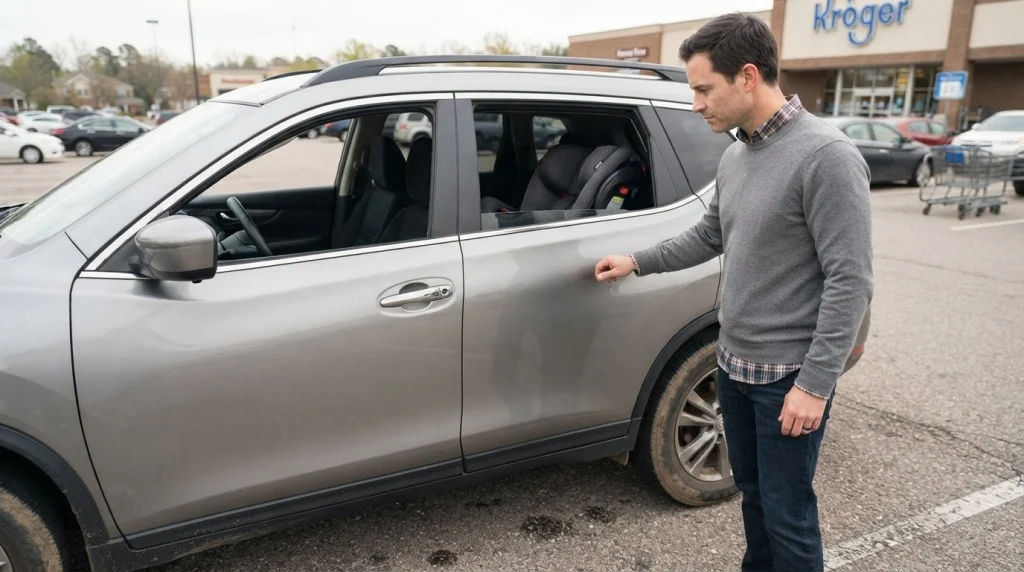
A minor accident is a collision that meets all five conditions established in NHTSA’s child car seat replacement guidance. It isn’t defined simply by a low driving speed or a small repair bill.
A collision that looks harmless from outside may still fail one of those conditions. That’s why I wouldn’t use bumper damage alone to make a safety decision.
The Five NHTSA Minor-Crash Criteria Explained
- The vehicle was drivable. The car remained capable of being driven away from the crash location.
- The nearest door was undamaged. The door closest to the child restraint sustained no collision damage.
- Nobody was injured. No passenger or other occupant inside the vehicle sustained an injury.
- No airbags deployed. Front, side, and curtain airbags remained undeployed during the accident.
- The car seat has no visible damage. There are no visible cracks, broken components, or other signs of damage to the child restraint.
Every condition matters. Passing four out of five does not qualify the accident as minor under these guidelines.
Minor Crash vs. Crash Requiring Replacement
| Crash Scenario | NHTSA Classification | Recommended Action |
|---|---|---|
| Light parking-lot collision; all five criteria satisfied | Minor crash | Reuse may be permitted if the manufacturer allows it. |
| Low-speed collision with airbag deployment | Fails minor-crash criteria | Replace the car seat. |
| Rear-end collision causing passenger injury | Fails minor-crash criteria | Replace the car seat. |
| Collision damages the door closest to the child seat | Fails minor-crash criteria | Replace the car seat. |
| Child seat has a cracked shell | Fails minor-crash criteria | Stop using and replace the seat. |
Imagine a vehicle with only a scratched bumper, but one side-curtain airbag deployed. The child seat might look untouched, yet the crash fails NHTSA’s minor-crash test.
That’s an important distinction. Visible cosmetic damage doesn’t reliably describe the forces involved in a collision.
Pro tip: Use NHTSA’s published criteria together with the instructions for your specific child restraint. Never treat the checklist as permission to ignore a stricter manufacturer policy.
Section Takeaway: A truly minor crash must satisfy all five NHTSA conditions. Appearance, speed, and repair cost cannot replace this checklist.
When Must a Car Seat Be Replaced After an Accident?
A child car seat must be replaced after a moderate or severe crash. Replacement is also necessary after a minor collision when the manufacturer requires it.
The same applies if the accident fails any NHTSA minor-crash condition. Don’t assume a child restraint remains safe because it still buckles normally.
Why Can a Car Seat Be Damaged Without Visible Cracks?
A child restraint is a safety system designed to manage crash forces. Its protective components include a structural shell, energy-absorbing materials, and restraint hardware.
Depending on the model, a collision may affect several components:
- Plastic shell: Crash forces can potentially cause structural cracks or other damage.
- Energy-absorbing foam: Foam components may crack or compress under impact forces.
- Harness webbing: Loaded straps may experience stresses that aren’t obvious afterward.
- Buckle hardware: Internal components can be affected even when the buckle still clicks.
- Base and anchor connections: Installation components may experience collision forces.
You cannot reliably determine a child restraint’s remaining crash protection through a simple visual inspection. That’s one reason manufacturers publish specific post-crash replacement rules.
Does the Car Seat Need Replacing if the Child Wasn’t in It?
Possibly, yes. An empty child car seat can still experience crash forces while secured inside a vehicle.
The child’s absence doesn’t automatically exempt the seat from replacement guidance. Apply the same crash criteria and model-specific instructions.
Does a Rear-End Collision Automatically Mean Replacement?
Not under NHTSA’s general guidance. A rear-end accident may qualify as minor when all five criteria are satisfied.
However, a rear-end collision that causes injury, airbag deployment, or other disqualifying conditions requires replacement. A manufacturer’s stricter rule also takes priority.
Do Booster Seats Follow the Same Rules?
Booster seats also need post-crash evaluation according to their manufacturer’s instructions. This includes high-back and backless boosters.
A booster may use the vehicle’s seat belt rather than an integrated five-point harness. That difference does not automatically make it safe to reuse after a collision.
Section Takeaway: Visible damage isn’t the only reason for replacement. A crash can affect child restraint components even when the seat looks normal.
Why Do Car Seat Manufacturers Have Different Replacement Rules?
Car seat manufacturers set their own post-crash instructions, and some are stricter than NHTSA’s general recommendations. As of 2026, major brands still differ in their approaches.
This makes your seat’s specific instruction manual an essential part of the decision. Two seats involved in the same minor crash may have different replacement requirements.
Graco: Replace After Any Accident
Graco’s official accident-replacement guidance recommends replacing a car seat after any type of accident.
Graco explains that collision forces may damage internal structural components without leaving visible signs. Its guidance also applies when the child restraint was unoccupied.
Britax: Some Minor Crashes May Qualify for Reuse
According to Britax’s United States crash FAQ, a car seat involved in a moderate or severe collision should no longer be used.
For minor collisions, Britax refers owners to NHTSA’s five conditions. Always confirm the instructions for the exact model and market where the seat was sold.
Chicco: Replacement Recommended After Every Crash
Chicco’s crash-replacement guidance recommends replacing its child car seats after a collision, even when the accident appears minor.
Chicco also advises replacing an infant car seat base that was inside the vehicle during a crash. An apparently undamaged base shouldn’t be treated as automatically reusable.
How to Find the Rules for Your Exact Seat
Brand-level summaries help, but product instructions provide the most relevant guidance. Policies may vary by model, production period, and sales region.
- Find the manufacturer’s name on the seat’s identification label.
- Record the exact model number and manufacture date.
- Locate the original instruction manual or its official online version.
- Find the section about collisions, accidents, or crash replacement.
- Contact customer support if the wording is unclear.
Provide the manufacturer with an accurate description of the collision. Mention any vehicle damage, injuries, and airbag deployment.
Ask whether the seat, detachable base, and relevant components require replacement. Keep a copy of the answer if you need to submit an insurance claim.
Pro tip: Manufacturer guidance differs across countries. Don’t apply advice from a United Kingdom or Australian manual to a United States model without confirming compatibility.
Section Takeaway: NHTSA permits possible reuse after qualifying minor crashes, but manufacturers can impose stricter replacement requirements. Always follow your specific product’s instructions.
How Do You Check a Car Seat After a Minor Accident?
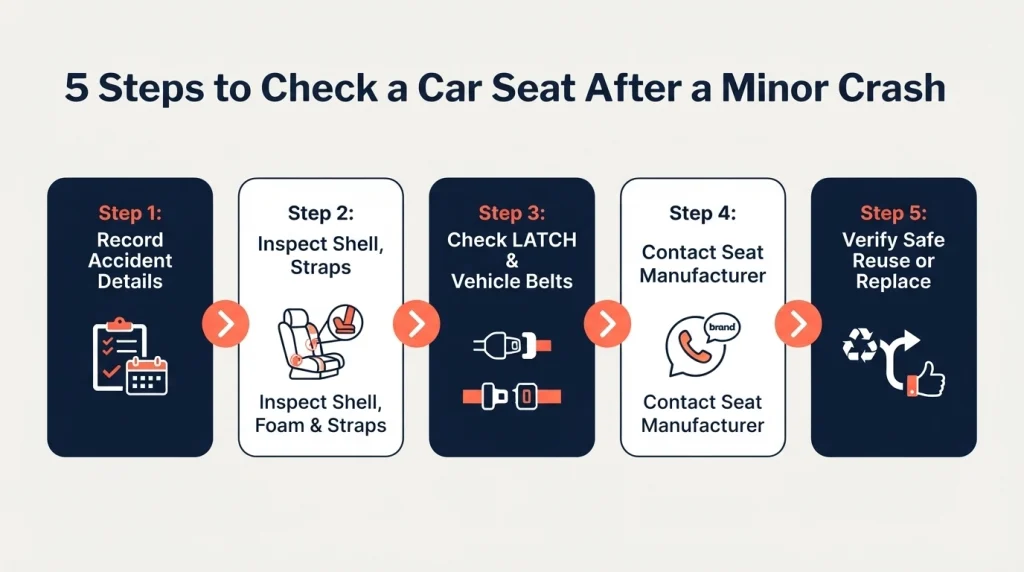
Start by documenting the collision and confirming whether the restraint can be reused under its manufacturer’s rules. A visual check can reveal damage, but it cannot certify that hidden components remain safe.
Until you have a clear answer, arrange another appropriate child restraint for necessary transportation. Never use an ordinary adult seat belt as a substitute for a child restraint a child still needs.
Step 1: Record the Accident Details
Write down what happened before the details become difficult to remember. Focus on facts connected to the NHTSA crash criteria.
- Where and how the collision occurred
- Whether the vehicle could be driven away
- Whether anyone in the vehicle was injured
- Whether any airbag deployed
- Which vehicle doors sustained damage
- Where each child restraint was installed
Step 2: Inspect for Obvious Damage
Look at the seat and accessible components without dismantling them. Stop using the restraint if you find visible damage.
Signs that deserve immediate attention include:
- Cracks or distortion in the plastic shell
- Broken or displaced energy-absorbing foam
- Frayed or visibly damaged harness straps
- Damaged buckles or harness adjusters
- Broken or distorted base components
- Damaged lower-anchor connectors or tether components
Remember that the absence of these signs isn’t proof of safety. Use the inspection only as one part of the overall decision.
Step 3: Check the Installation System
The child restraint and vehicle work together during a collision. Vehicle seat belts, lower anchors, tether anchors, and related hardware may also need evaluation.
Lower anchors and tethers for children, commonly called Latch in the United States, are designed to secure child restraints. Follow the vehicle manufacturer’s inspection or repair instructions after a crash.
If you suspect damage to the vehicle’s restraint hardware, have it assessed by a qualified professional. Don’t reuse questionable mounting hardware simply because a replacement seat is available.
Step 4: Contact the Manufacturer
Give the manufacturer your model information and a factual crash description. Ask for a clear decision about replacement.
You can use a short message such as:
My child car seat was installed in a vehicle involved in a collision. The model number is [model], and the manufacture date is [date]. Based on the crash details, does the seat or its base require replacement?
Step 5: Decide Whether the Seat Can Stay in Service
Only consider continued use when the accident meets every NHTSA minor-crash criterion and the manufacturer permits reuse. The seat must also remain within its permitted service life and otherwise meet all instructions.
If a requirement fails, stop using the affected restraint. Don’t attempt a home repair or replace individual safety components unless the manufacturer explicitly authorizes the procedure.
Section Takeaway: Document, inspect, verify, and follow manufacturer guidance. No visual inspection can override a replacement requirement.
Will Insurance Cover Car Seat Replacement After a Crash?
Car insurance may cover replacing a child safety seat after an accident, but reimbursement isn’t guaranteed. Coverage depends on the insurance policy, claim circumstances, and applicable local rules.
In the United States, the relevant claim may involve your own insurer or another driver’s insurance company. Ask which policy and coverage provisions apply before purchasing a replacement when practical.
What Documents Does Insurance Usually Need?
Insurers may request evidence of the collision and the seat’s replacement requirement. Gather documentation as early as possible.
- Accident details: Claim number, incident date, and police report when available.
- Car seat identification: Brand, model number, and manufacture date.
- Photographs: Images of the restraint, its label, and relevant vehicle damage.
- Replacement instructions: The manufacturer manual or written accident-replacement policy.
- Purchase records: Original receipt if available and replacement receipt if purchased.
- Manufacturer confirmation: Written guidance when the insurer requests additional proof.
How to Request Reimbursement
- Contact the insurer handling the accident claim.
- Explain that a child restraint was inside the vehicle.
- Ask about replacement-seat reimbursement and documentation requirements.
- Submit the manufacturer’s applicable post-crash instructions.
- Provide an itemized replacement receipt if requested.
- Keep copies of all communications and claim decisions.
Ask whether the claim covers a comparable replacement seat and any separate infant seat base. Confirm whether an approved equivalent model is acceptable.
What if the Insurance Company Denies Replacement?
Request a written explanation of the denial. Then compare the insurer’s reasoning with the actual manufacturer instructions.
If the manufacturer requires replacement, provide that written policy and ask for reconsideration through the insurer’s review process. Local consumer insurance authorities may also explain available complaint or appeal options.
Most importantly, don’t continue using a seat that requires replacement simply because reimbursement was denied. Insurance decisions do not determine whether a restraint is safe.
Section Takeaway: Document the car seat early and support your claim with manufacturer instructions. Replacement safety requirements remain important regardless of the insurer’s decision.
How Do You Replace and Dispose of a Crashed Car Seat?
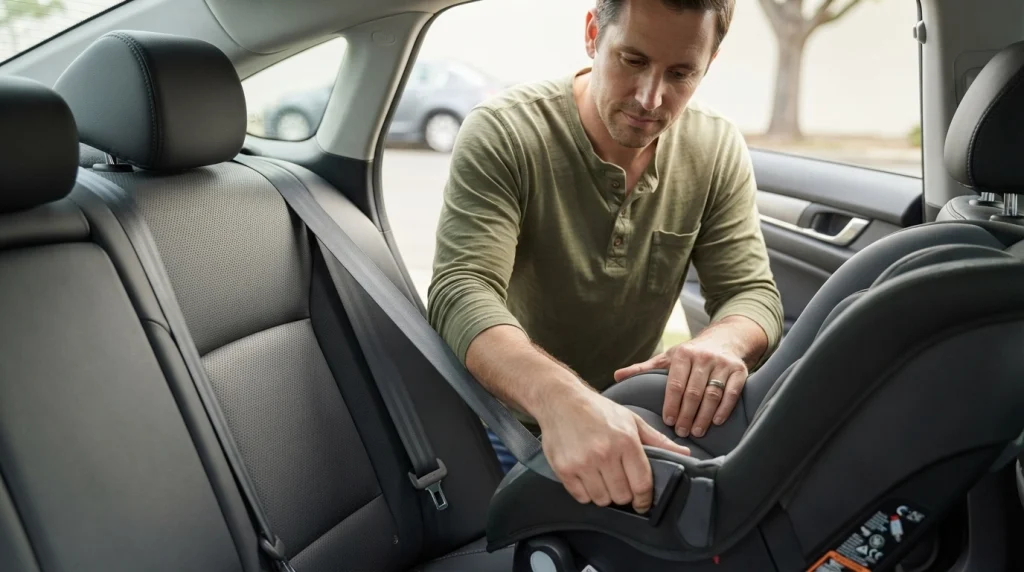
Replace a crashed child restraint with a new, appropriate seat that fits your child and vehicle. Choose the correct restraint type using the manufacturer’s height, weight, and installation requirements.
A replacement doesn’t necessarily need to be the same model. What matters is that the new restraint is approved for your market and properly fitted to your child and vehicle.
Choosing the Right Replacement Car Seat
Before buying, compare the child’s current measurements with the seat’s stated limits. Check compatibility with the vehicle’s seating position and installation method.
- Rear-facing infant seat: Appropriate for children within the specified rear-facing limits.
- Convertible seat: Designed to support rear-facing and later forward-facing use within its limits.
- All-in-one seat: May accommodate several stages, depending on model specifications.
- Forward-facing harness seat: Intended for children meeting the manufacturer’s forward-facing requirements.
- Belt-positioning booster: Helps position the vehicle belt correctly for children who are ready for booster use.
Don’t move a child to the next restraint stage solely because an accident forced a purchase. Continue rear-facing or using a harness as long as the child’s current stage and seat limits allow.
Installing the New Seat Correctly
Read both the child seat instructions and the vehicle owner’s manual. These documents determine which seating positions and installation methods are permitted.
According to NHTSA’s car seat installation guidance, a correctly secured seat should move no more than one inch at its belt path when tested side to side or front to back.
Check these installation points before using the replacement:
- The seat is installed in an approved vehicle seating position.
- The seat belt or lower-anchor installation follows both manuals.
- The restraint moves no more than one inch at the belt path.
- Rear-facing recline follows the seat’s angle indicator or instructions.
- A forward-facing tether is connected when required.
- The harness is positioned and tightened according to the child’s restraint instructions.
A certified Child Passenger Safety Technician can help identify installation problems. This assistance is especially useful after changing vehicles, restraints, or installation methods.
What Should You Do With the Old Crashed Seat?
A child restraint that has been retired because of a collision shouldn’t be sold, donated, or passed to another family. Someone else may not know its crash history.
Before disposal, follow the manufacturer’s instructions and check whether local recycling programs accept child restraints.
- Confirm that the seat has permanently been removed from service.
- Remove reusable accessories only when allowed by the manufacturer.
- Make the retired seat unusable, such as cutting harness straps, when appropriate for disposal.
- Clearly mark the seat as crashed and unsafe for reuse.
- Follow local waste or recycling requirements.
Some recycling programs have their own preparation requirements. Check them before dismantling anything.
Pro tip: If your vehicle’s seat belts, anchors, or other safety components were affected, follow the vehicle manufacturer’s service instructions before installing the replacement restraint.
Section Takeaway: Select the right restraint for your child, install it correctly, and prevent a retired crash seat from returning to use.
Frequently Asked Questions
1. Does a car seat need replacing after a minor rear-end accident?
Not necessarily. A rear-end accident may qualify as minor under NHTSA’s guidelines when all five conditions are met. However, a manufacturer may require replacement after every collision, so review the instructions for the exact child restraint before reusing it.
2. Should I replace a car seat after a parking-lot bump?
It depends on the nature of the incident and the manufacturer’s policy. A minor parking-lot collision may meet NHTSA’s criteria, but that alone doesn’t guarantee reuse is permitted. If the situation is unclear, contact the manufacturer with the incident details.
3. Can a car seat be damaged in a 5 mph accident?
Potentially, yes. Speed alone cannot determine whether a child restraint sustained damage or qualifies for reuse. NHTSA uses five specific crash conditions rather than a universal speed cutoff, and manufacturers may have stricter replacement instructions.
4. Do I need to replace an infant car seat base after an accident?
You may need to replace the base even if the infant carrier wasn’t attached during the crash. Some manufacturers require replacement of any base present in a collision. Consult the instructions for both components and contact the manufacturer when uncertain.
5. Can I keep using a car seat if there’s no visible damage?
Only when reuse is permitted under the applicable crash and manufacturer guidance. Hidden damage cannot always be identified visually. An undamaged appearance does not override instructions requiring replacement after a collision.
6. Will insurance replace a car seat if my child wasn’t in it?
Insurance may cover the restraint even when it was unoccupied, depending on the policy and claim. Manufacturers can require replacement of empty seats exposed to a collision. Provide the insurer with the model information and relevant replacement instructions.
7. Can a mechanic inspect my car seat and declare it safe?
A mechanic can help assess the vehicle’s damaged components, but an ordinary inspection cannot guarantee the child restraint’s crash protection. Reuse decisions should follow the car seat manufacturer’s instructions and applicable crash criteria, rather than an informal visual assessment.
Final Takeaway: Safety Comes Before Appearance
So, does a car seat need replacing after a minor accident? The answer depends on whether the crash meets all five NHTSA conditions and whether your particular manufacturer allows continued use.
Never assume a restraint is safe just because the collision was slow or the seat looks undamaged. Check the manual, document the crash, and ask the manufacturer when anything remains unclear.
Your next step: Find the seat’s model number and post-crash instructions today. If replacement is required, arrange an appropriate new child restraint before your child’s next car journey.

Daniel Brooks is an automotive writer and product researcher focused on car accessories, car tech, maintenance, and practical driving guides. At Plug-in Car World, he helps drivers make smarter automotive decisions through honest reviews and research-driven content.
