
Car Seat Crotch Buckle Adjustment: What Parents Need to Know
Quick Answer
To adjust the car seat crotch buckle position, move the crotch strap to the slot closest to your child without placing it underneath them, then check that the metal retainer sits flat and the buckle clicks fully shut. Always follow your own seat manual first, because slot layouts and release methods differ by model. For the official safety background, see NHTSA.
Get the position right
- Manual first: Your seat manual names the allowed slots and the correct release method for your model.
- Closest slot: Use the slot nearest your child that still leaves the buckle in front of their body.
- Not underneath: The buckle should never sit under your child or press into their legs.
- Flat retainer: The metal clip under the seat must lie flat after rethreading.
- Full click: Both harness tongues must lock into the buckle before every ride.
Before you drive
- Remove twists from the crotch strap and harness straps.
- Do the pinch test on the harness at your child’s collarbone after buckling.
If you have ever stared at the slots under a child car seat and wondered which one is right, you are not alone.
This guide walks through the crotch buckle position in plain steps, so you can check it, move it, and recheck it without guessing. It also covers seat covers, because a cover can hide a slot or change how the buckle sits.
In This Guide
What Is a Car Seat Crotch Buckle and Why Does Its Position Matter?
A car seat crotch buckle is the buckle between a child’s legs that locks the two harness tongues together. It anchors the lower part of the harness, so the straps stay in place during normal driving and in a crash.
The crotch strap runs from that buckle down through a slot in the seat shell. Many seats offer two or three slots, spaced to suit a growing child.
Position matters because the buckle sets where the harness pulls from below. Too far back, and it can dig in or sit under the child.
Too far forward, and the harness may not hold the hips as snugly as it should. The right slot keeps the buckle close, flat, and easy to fasten without forcing it.
Think of the parts as a small set you should recognise before you adjust anything:
- Buckle: the latch your child’s harness tongues click into.
- Crotch strap: the short strap fixed to the buckle.
- Slot: the opening in the seat shell the strap passes through.
- Retainer: the flat metal piece that stops the strap pulling back through the slot.
Pro tip: If any part looks cracked, frayed, or sticky, check your seat manual and contact the manufacturer before reuse, and confirm current safety guidance through your vehicle and seat manuals.
Section takeaway: The crotch buckle anchors the lower harness, and its slot should place it close to your child without sitting underneath them.
What Is the Correct Crotch Buckle Position?
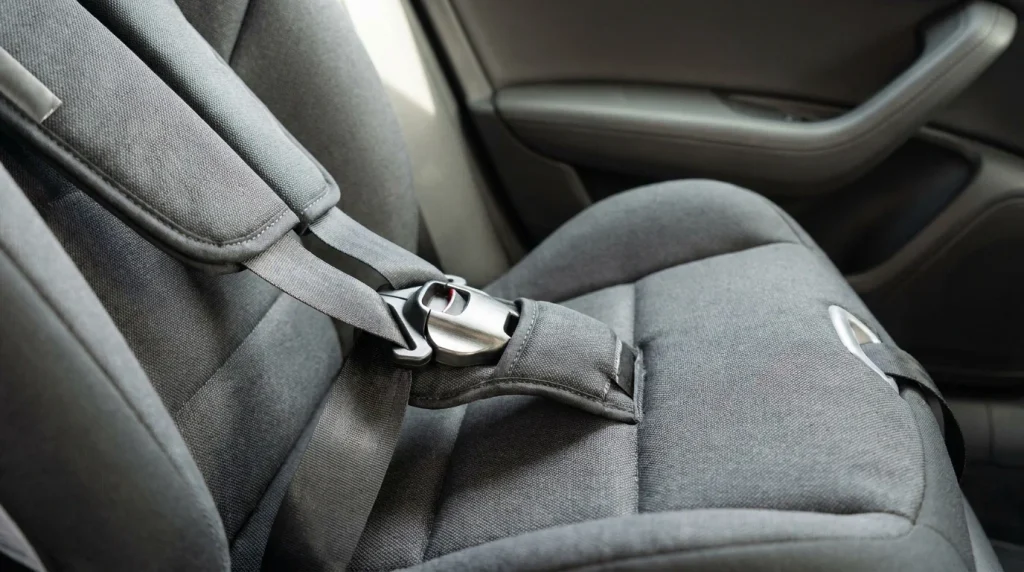
The correct crotch buckle position is the slot closest to your child that does not put the buckle under their body. That rule works as a starting point for most rear-facing and forward-facing seats.
Seat makers still differ on details, so the manual for your exact model wins over any general rule. Some seats use a sliding buckle, while others need full rethreading through a new slot.
Check the buckle with your child seated and harnessed, but only after you have already moved and secured the strap. Look for a buckle that sits just in front of the body, with no sharp bend in the strap.
The harness should then tighten evenly, without pulling the buckle sideways. If the buckle tilts hard to one side, recheck the strap path and the retainer underneath.
| Buckle position | What you will see | What to do |
|---|---|---|
| Too close | Buckle presses into the legs or sits under the child | Move the strap one slot forward, if your manual allows it |
| Correct | Buckle sits just in front of the body and clicks shut easily | Leave it, then tighten and pinch-test the harness |
| Too far forward | A clear gap sits between the buckle and the child’s body | Move the strap one slot back, if your manual allows it |
Do not judge position by comfort alone, because a child may prefer a looser fit. Judge it by slot placement, strap angle, and a snug harness check.
Section takeaway: Choose the nearest slot that keeps the buckle in front of your child, then confirm the harness still tightens evenly.
How Do You Adjust the Crotch Buckle Position?
Work on a flat surface with good light, and take the child out first. You will need clearer access underneath the seat than you get with a child sitting in it.
Read the crotch-strap section of your manual before you touch the strap. The release method, slot order, and any length adjustment differ enough that a guess can leave the retainer half-seated.
- Loosen the harness and unbuckle both tongues, then lift the seat cover edge near the buckle if your manual shows that step.
- Find the slot the crotch strap currently uses, and note the strap path before you move anything.
- Reach underneath the seat and turn the metal retainer so it lines up with the slot.
- Push the retainer and strap up through the slot, keeping the strap flat and untwisted.
- Thread the strap down through your chosen slot from above, following the same flat path.
- Turn the retainer flat underneath the shell and tug firmly to confirm it cannot pull back through.
- Replace the cover, buckle both tongues, and check that the buckle sits just in front of your child’s body.
Some seats also let you shorten or lengthen the crotch strap itself, often through a loop or adjuster underneath. Use that only if your manual describes it, and recheck the buckle position after any length change.
Never force a retainer through a slot that feels too small, and never leave a strap twisted to make it fit. A twisted strap can hide wear, change how it tightens, and make a later check harder.
Pro tip: Take a photo of the original strap path before you move it, so you can compare the new path side by side with the manual diagram.
Section takeaway: Move the strap slot by slot, keep it flat, seat the retainer fully, and recheck the buckle with the harness fastened.
How Does a Seat Cover Affect the Buckle?
A seat cover can change the buckle position in two quiet ways. Thick padding can push the buckle forward, while a bunched cover can hide the slot you need.
That distinction matters for the topic here, because “car seat covers” can mean two different products. One is a cover for the adult car seat, and the other is a cover made for a child car seat.
Use only a cover approved for your exact child seat model, or one supplied by that seat maker. An unapproved cover can sit under the harness, change strap routing, or add slack you cannot see.
Before every ride, smooth the cover around the buckle area and confirm the buckle still clicks shut without trapping fabric. If fabric keeps catching in the latch, remove the cover and check the fit without it.
When you shop for adult-seat covers, fit and buckle access still matter, though the safety stakes differ. A well-fitted cover should not bunch over a child seat’s base or block its belt path.
- Cooling car seat cover review: useful if heat and bunching fabric are your main complaints.
- Sprints car seat cover review: worth reading if you want a closer look at fit and everyday use.
- Astonish car seat cover review: helpful if you are comparing cover materials and coverage.
Do not cut a new buckle hole in a cover, and do not route the crotch strap around a cover edge. Either shortcut can change the strap angle and void the seat maker’s instructions.
Section takeaway: A cover must never hide a slot, trap fabric in the buckle, or sit under the harness unless the seat maker approves it.
What Mistakes Should You Avoid?
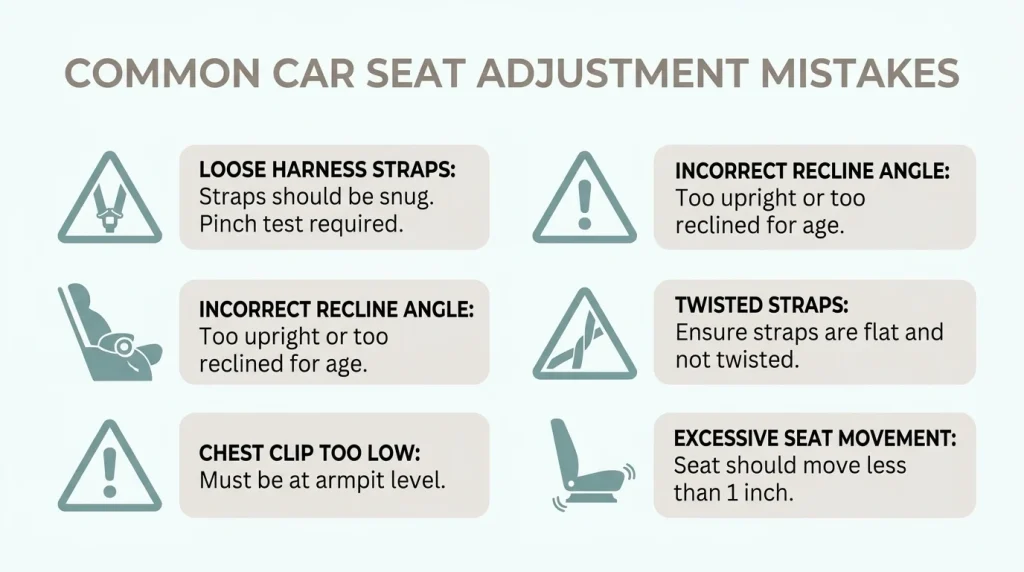
Most buckle problems come from small oversights, not broken parts. A quick check after each adjustment catches most of them before a drive.
Run through this list after you move a slot, change a cover, or wash the seat padding:
- Twisted strap: untwist the crotch strap fully, because a twist can change how it lies and tightens.
- Half-seated retainer: press and tug the retainer until it lies flat and holds firm underneath.
- Wrong slot: return to the closest slot that keeps the buckle in front of your child.
- Trapped fabric: clear cover fabric, blankets, and bulky clothing from the buckle before latching.
- Loose harness: tighten the harness until you cannot pinch slack at the collarbone.
- Aftermarket add-ons: skip unapproved buckle pads or strap covers that change the buckle’s position.
Bulky coats cause a related problem, even when the buckle slot is perfect. A thick coat can compress in a crash and leave slack you did not notice during buckling.
For general child-passenger guidance from a paediatric source, see HealthyChildren.org. Your seat manual still governs your specific model.
Section takeaway: Check for twists, a flat retainer, trapped fabric, and a snug harness every time you change the buckle position.
When Should You Move the Buckle Again?
Move the buckle again when your child grows enough that the current slot sits under them or presses into their legs. Growth spurts, a move from rear-facing to forward-facing, and a new seat can all trigger that check.
As of 2026, the practical habit is simple: check the buckle position at the same time you check harness height. Both change as a child grows, and checking them together avoids a half-updated fit.
Watch for these signs between manual checks:
- The buckle digs in or leaves a mark after a short ride.
- You struggle to click both tongues shut without pulling fabric clear.
- The harness tightens unevenly or pulls the buckle sideways.
- Your child has clearly outgrown the padding or cover around the buckle area.
If your seat has only one crotch slot, you do not need to invent a second position. Follow the manual for that model, check harness height and tightness, and contact the maker if the fit looks wrong.
When in doubt, ask a certified child passenger safety technician to check the install in person. For independent product and safety reporting, see Consumer Reports.
Section takeaway: Recheck the buckle whenever growth, a new seat, or a new cover changes the fit, and get an in-person check if anything looks off.
Frequently Asked Questions
Can I adjust the crotch buckle while my child is in the seat?
No. Take the child out first, then loosen the harness and adjust the strap with clearer access underneath the seat. Adjusting under a seated child can hide a twisted strap, a half-seated retainer, or a slot that is still too close.
Should the buckle sit underneath my child?
No. The buckle should sit just in front of your child’s body, in the closest slot that achieves that position. A buckle underneath the child can press into their legs, make buckling harder, and signal that the strap needs to move forward.
Does moving the buckle change how tight the harness should be?
No, the harness tightness rule stays the same after any buckle move. Tighten the straps until you cannot pinch slack at your child’s collarbone, then recheck the chest clip and buckle. A new slot should improve fit, not excuse a loose harness.
Can an aftermarket seat cover change the buckle position?
Yes, if it adds padding, bunches near the slot, or sits under the harness. Use only covers approved for your exact seat model, smooth fabric away from the buckle, and remove the cover if it traps fabric or changes the strap path.
What if my car seat has only one crotch buckle slot?
Use that slot as designed, and focus on harness height, harness tightness, and correct installation. Do not drill a new slot or reroute the strap around the shell. If the fit still looks wrong, contact the seat manufacturer or a certified technician.
What should I do if the crotch strap is twisted?
Untwist it fully before buckling, and trace the strap from the buckle to the retainer underneath. A twist can affect comfort, hide damage, and make tightening uneven. Replace the strap through the manufacturer if it stays twisted or shows fraying.
Final check: Move one slot at a time, keep the strap flat, seat the retainer fully, and recheck the harness before every ride. If your manual and this guide ever disagree, follow your manual.

Daniel Brooks is an automotive writer and product researcher focused on car accessories, car tech, maintenance, and practical driving guides. At Plug-in Car World, he helps drivers make smarter automotive decisions through honest reviews and research-driven content.
